
There is no typical colony
An ant colony is a society, not a fixed-size container. Some species live in tiny cavities with tens of workers. Others build mature societies of thousands or millions. Comparing them with one average erases the biology that makes each strategy work.
Colony age matters too. A newly founded nest can consist of a queen and brood. Worker numbers then rise, sometimes for years, before reproduction, resource limits and seasonal conditions reshape the population.
What counts as one colony?
A colony is defined by social cooperation and acceptance, not necessarily by a single mound. One colony may occupy one nest, several nearby nests or a network spread across a landscape.
This is why counts for supercolonies need careful wording. Researchers may estimate workers, nests or territory rather than physically count every individual. A spectacular regional estimate should not be presented as the size of an ordinary backyard nest.
Workers, queens and brood
When people ask how many ants are in a colony, they usually mean visible workers. A full census would also include one or more queens, males during reproductive periods, and eggs, larvae and pupae.
Queen number varies by species and sometimes within a species. It can influence how a colony grows, reproduces and spreads, but more queens do not translate into a simple fixed multiplier.
How scientists estimate the number
Small nests can sometimes be excavated and counted. Larger systems require sampling: researchers may measure nest area, count ants moving through entrances, estimate occupied nests or use marked individuals to infer population size.
Every method has limits. Workers can be underground, activity changes with weather, and connected nests make borders difficult to draw. Good estimates state what was measured and how uncertainty was handled.
A better way to answer
For identification or control, species and nest location matter more than a headline number. For biology, ask whether the colony is young or mature, single-nested or multi-nested, and whether the figure includes brood.
The defensible general range is broad: tens to millions. Any claim more precise than that should name the ant and the evidence behind the count.
Every colony begins with a severe bottleneck
A familiar founding pattern begins after mating, when a queen sheds her wings, finds a protected cavity and raises the first brood. At that stage the “colony” may be one adult plus eggs and larvae. The first workers are often small because the founder is producing them from limited stored resources.
Founding is risky. A suitable chamber can flood, dry out, overheat or be discovered by a predator, and the first brood can fail. The large mature colony people picture is therefore the survivor of many filters, not the automatic result of seeing a newly mated queen.
Growth changes what a colony can do
Ten workers cannot forage, defend several entrances, regulate brood conditions and maintain a large nest with the redundancy available to ten thousand. As worker number rises, a colony can place more ants on specialized or risky tasks while keeping essential work going elsewhere.
Size can also alter foraging decisions. A larger colony may discover resources faster, recruit more strongly or exploit patches a small colony cannot defend. This is one reason a number without species and method tells only part of the story: colony size is not merely a statistic; it changes the society’s options.
One nest is not always one colony
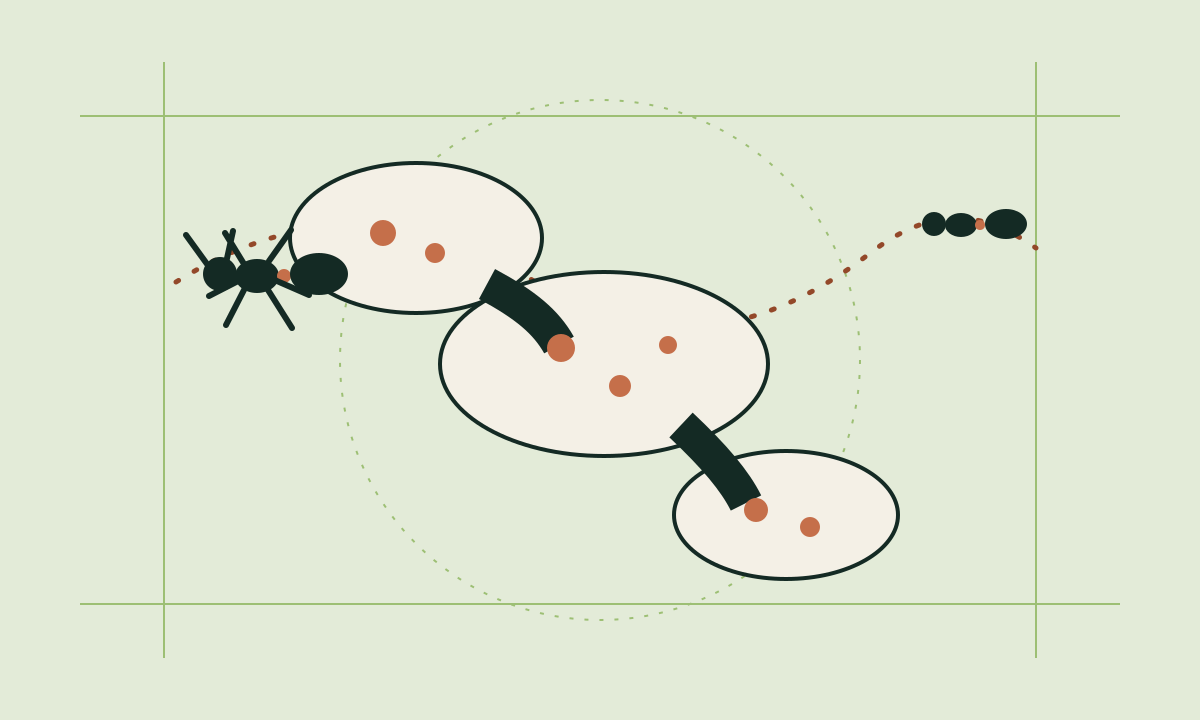
Some colonies occupy several nests, a condition called polydomy. Workers and brood may move between sites, while food and information flow across the network. Counting the ants in one cavity would then be like estimating a city from one apartment building.
At the largest scale, compatible nests can form vast connected populations often described as supercolonies. Their reported extent may refer to territory, nest count or genetic and behavioral compatibility—not a single underground hall containing an impossible heap of ants. Headlines tend to lose that distinction because “many cooperating nests” has fewer fireworks than “one enormous colony.”
How to interpret the colony in front of you
Visible traffic is not a census. Activity falls in cool weather, shifts between day and night, and changes with food availability. A quiet entrance can lead to a large nest, while an intense trail may simply reflect a short-lived resource.
For a useful field note, record species or best identification, date, weather, nest material, number of active entrances and a timed count of workers crossing one point. Repeat the count under similar conditions. You still will not know the exact population, but you will have comparable evidence instead of a heroic guess.
- Do not excavate a wild nest simply to count it.
- State whether a figure includes workers only or all life stages.
- Treat unusually precise online totals cautiously unless the counting method is given.
Sources and review notes
EveryAnt prioritizes peer-reviewed, university, museum and government sources. These pages have completed an internal source and scope pass; independent subject-matter review remains recommended before a production launch.
- Ant colonies — Australian Museum. Accessed 2026-09-05.
- Quantifying the Effect of Colony Size and Food Distribution on Harvester Ant Foraging — PLOS ONE / PubMed Central. Accessed 2026-09-05.