
What happens to an ant colony when the queen dies?
The important distinction is between workers staying alive and a colony continuing to produce new generations. Queen loss does not necessarily end the first immediately, but it can prevent the second.
A queen is primarily a reproductive individual, not a commander issuing instructions. Workers can continue their activities after her death. What happens next depends on which reproductives remain, the brood already present and the species’ capacity for replacement.
Scroll sideways to see all columns.
| Situation | What can happen immediately? | Longer-term outcome |
|---|---|---|
| The only functioning queen dies, with no successful replacement | Workers remain alive; existing female brood may continue developing | Once that brood is exhausted, new-worker production stops and the workforce eventually dwindles |
| Another functioning queen remains | Worker activity and brood care can continue | The remaining queen or queens may maintain worker production |
| A replacement successfully takes over reproduction | The transition depends on the species and how replacement occurs | The colony may continue producing workers; the presence of a queen-shaped ant alone does not establish success |
| The species has workers capable of taking over female reproduction | Some workers may enter a reproductive transition | In documented species, reproductive workers can maintain the colony; this is not a general ability of ant workers |
Research on queen replacement and reproductive workers documents several possible outcomes. They should not be treated as equally available to every colony. Fire-ant replacement study; research on Harpegnathos reproductive workers.
A closer look
After queen loss
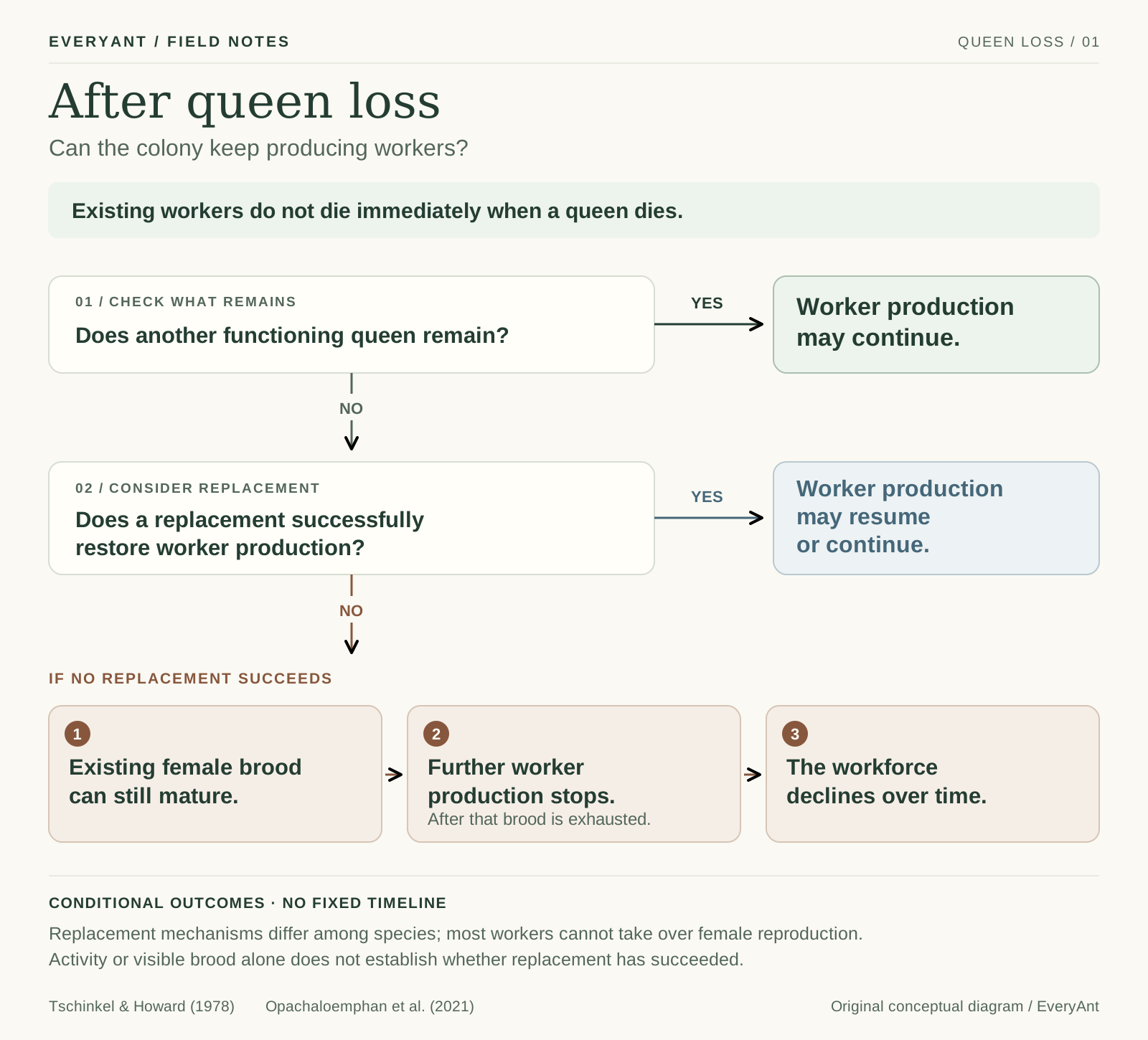
After queen loss, the outcome depends on remaining reproductives and successful replacement. These are conditional pathways, not a timetable or a way to diagnose a colony from activity alone.
How long do ants live without a queen?
There is no single reliable lifespan for ants living without a queen. The remaining lifespan of an individual worker depends on its species, age, condition and surroundings. How long the colony persists also depends on its existing brood and whether it can restore worker production.
Those are different questions. A worker can remain alive without helping to produce another generation of workers. Conversely, workers emerging after queen loss may have developed from eggs laid while the queen was still alive.
Research also shows that queen absence does not affect worker survival in the same way across species. In an experiment with Temnothorax longispinosus, workers survived longer in queenless nests than in nests with queens. Kohlmeier and colleagues, 2017.
A different experiment followed Tapinoma magnum workers for 58 days and found the highest worker mortality in queenless groups. That was the study’s observation period—not a claim that queenless ants live for exactly 58 days. Lenhart and colleagues, 2025.
The useful answer is therefore conditional: without renewed worker production, a colony persists only while its remaining workers and developing brood can sustain it. A universal countdown would conceal important differences between colonies.
A closer look
The work continues. Replacement changes.
A conceptual sequence for a single-queen colony without a successful replacement.
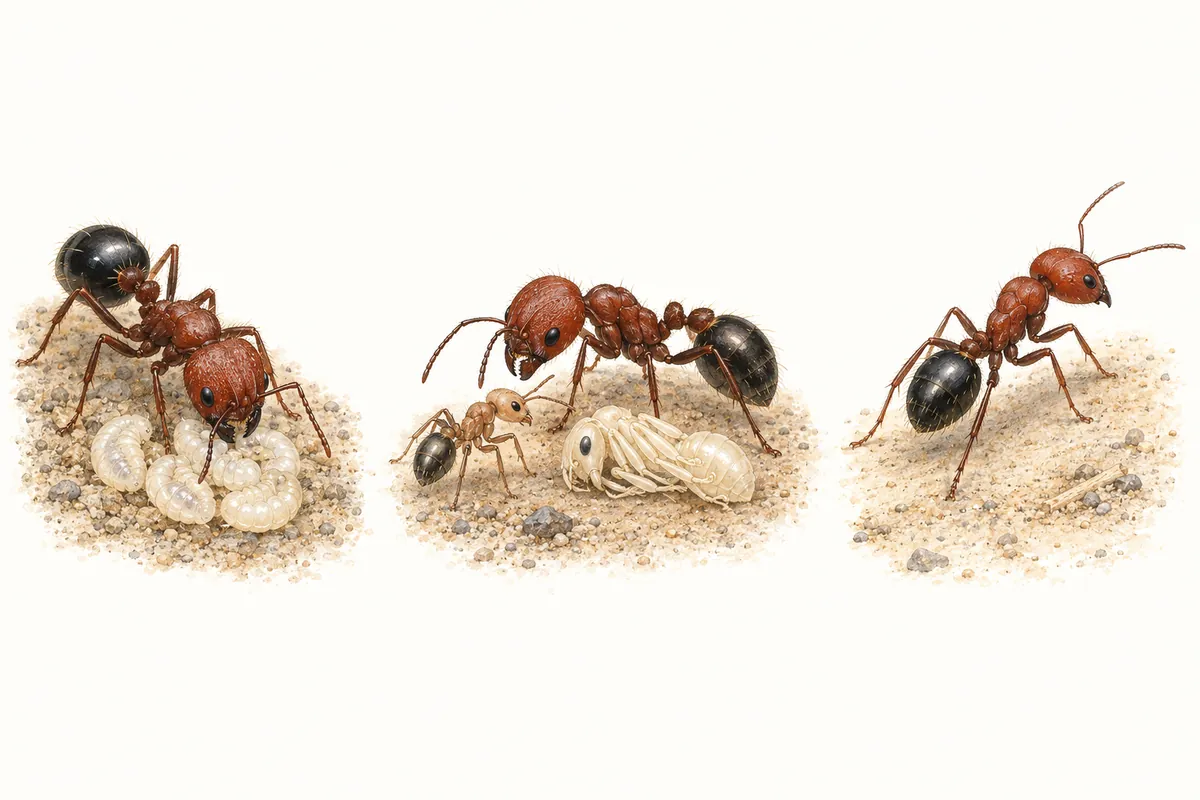
Harvester-ant-inspired forms (Messor barbarus) illustrate a conditional sequence: existing female brood can mature, but worker replacement eventually stops in a single-queen colony without successful replacement. No counts, scale or duration are measured.
Existing work (continues)
Workers can continue caring for brood after the queen is lost.
Existing brood (can mature)
Female brood already present can still become workers; loss is not an immediate shutdown.
New workers (eventually cease)
Without a fertile replacement, worker renewal stops after existing female brood matures.
Existing brood can still produce workers. The final stage applies after that female brood is exhausted and assumes no successful queen replacement; timing and outcomes vary. The exposed pupa is illustrative; brood development and appearance vary among species.
If the queen ant dies, who takes over?
In many species, no worker simply becomes the replacement queen. Another functioning queen may already be present, or the colony may have a species-specific route to replacement. Where neither applies, worker production eventually ends.
“Taking over” means restoring reproduction, not becoming the colony’s leader. A newly emerged queen is not automatically a successful replacement: her ability to produce workers matters.
Some species provide genuine exceptions. In the Indian jumping ant, Harpegnathos saltator, workers can become reproductive individuals called gamergates. These mated workers can assume the reproductive role after the loss of reproductives. They remain distinct from the usual queen caste. Research on caste transition in Harpegnathos.
This differs from species that naturally lack a queen caste. Both arrangements help explain ant diversity, but neither means an ordinary worker from any species can replace a queen.
Can workers lay eggs or become queens?
Some ant workers can lay eggs, but egg-laying does not necessarily restore the workforce.
In the usual reproductive system, fertilised eggs develop into females, including workers, while unfertilised eggs develop into males. Workers in many species cannot mate, so their reproductive eggs generally produce males. Other workers are sterile or produce non-developing eggs used as food. Female-producing worker reproduction exists in particular species, but it is an exception that needs to be identified explicitly. Bourke’s review of worker reproduction; Tapinoma research.
Producing males can contribute to reproduction, but it does not replace the female workforce.
For the separate question of how queen and worker castes develop, see how an ant becomes a queen.
How can you tell whether a colony is queenless?
A busy nest is not proof that its queen is alive. Equally, a quiet nest or a temporary absence of visible eggs does not establish that she has died.
Interpret observations together, with the species and the colony’s recent history in mind.
Scroll sideways to see all columns.
| Observation | Possible explanation | What it does not establish |
|---|---|---|
| Workers continue foraging and tending brood | Existing workers remain active after queen loss | That a functioning queen is present |
| Eggs are visible | Eggs may remain from earlier laying; workers can lay eggs in some species | That the eggs will develop into workers |
| Worker pupae or newly emerged workers are present | Female brood produced before queen loss may still be developing | That a queen is alive now |
| Male brood appears | Males may be part of normal reproduction or follow worker reproduction after queen loss | That every colony producing males is queenless |
| Worker numbers decline | Deaths are exceeding worker recruitment | The cause of decline, or when a queen may have died |
The central limitation is that brood has a history. What you see today may reflect reproduction before the queen disappeared. A single inspection cannot reliably resolve every case.
If identification is uncertain, our queen-ant size guide explains why size alone is insufficient.
What happens if a carpenter-ant queen dies?
If a carpenter-ant colony loses its only functioning queen and no replacement succeeds, the same distinction applies: existing workers may persist, but continued worker production is the longer-term problem.
However, a nest without a queen is not necessarily a queenless colony. Carpenter ants can occupy satellite nests connected to a parent nest where the queen—or queens—reside. Some species also maintain multiple queens. University of California IPM.
Finding workers without a queen, or finding one dead queen, therefore does not by itself reveal the reproductive state of the entire colony.
Our colony-size guide explains the difference between one nest and one colony.
What one fire-ant study found
A study of Solenopsis invicta illustrates why replacement requires careful interpretation.
After researchers removed functioning queens, they revisited field colonies 8–10 weeks later. Replacement queens were present in 61% of the colonies. Their presence did not mean all had restored normal reproduction.
Laboratory follow-up reported 21% of colonies with an inseminated queen and worker-pupa production. Combining laboratory and field evidence, the researchers estimated 27% had fertile replacements. These figures describe different assessments, not interchangeable recovery rates.
Successful replacements were concentrated in smaller, younger colonies. The researchers proposed that some replacements were surviving, previously mated founding queens—not queens newly raised after the loss. Tschinkel and Howard, 1978.
This study demonstrates that replacement can occur. It does not provide a universal probability of recovery or a survival deadline for other ants.
Further reading
Sources and review notes
EveryAnt prioritizes peer-reviewed, university, museum and government sources. Internal source checks do not replace independent specialist review.
- Queen replacement in orphaned colonies of the fire ant, Solenopsis invictaTschinkel & Howard (1978), Behavioral Ecology and Sociobiology · Accessed 2026-10-15
- Early behavioral and molecular events leading to caste switching in the ant HarpegnathosOpachaloemphan et al. (2021), Genes & Development · Accessed 2026-10-15
- Intrinsic worker mortality depends on behavioral caste and the queens’ presence in a social insectKohlmeier et al. (2017), The Science of Nature · Accessed 2026-10-15
- Worker Survival and Egg Production—But Not Transcriptional Activity—Respond to Queen Number in the Highly Polygynous, Invasive Ant Tapinoma magnumLenhart et al. (2025), Molecular Ecology · Accessed 2026-10-15
- Worker Reproduction in the Higher Eusocial HymenopteraBourke (1988), The Quarterly Review of Biology · Accessed 2026-10-15
- Carpenter AntsUniversity of California Statewide IPM Program · Accessed 2026-10-15
- Messor barbarus — specimen and taxon referenceAntWeb · Accessed 2026-09-22
Visual inspiration for the retained generated illustration; not a verification of species identity or evidence of queenless survival.