
Queen ant size by species
The table below gives published measurements for four species. It also shows why “bigger than the other ants” is only a starting point: workers themselves can vary considerably in size.
Scroll sideways to see all columns.
| Species | Queen body length | Worker body length |
|---|---|---|
| Pharaoh ant — Monomorium pharaonis | About 4 mm / 0.16 in | 1.5–2 mm |
| Black garden ant — Lasius niger | 8–9 mm / 0.31–0.35 in | 3.5–5 mm |
| Red imported fire ant — Solenopsis invicta | About 9.5 mm / 0.38 in | 1.5–5 mm |
| Black carpenter ant — Camponotus pennsylvanicus | 13.9–17.7 mm / 0.55–0.70 in* | Minor workers: 5.2–6.8 mm; major workers: 10.5–12.7 mm* |
Sources: University of Florida: pharaoh ants; Collingwood: black garden ants; Texas A&M: red imported fire ants; Mississippi Entomological Museum: black carpenter ants.
These are published examples and ranges, rather than guaranteed limits for every individual. Inch equivalents are rounded.
The black carpenter ant measurements come from a museum sample of six queens, six minor workers, and five major workers. The table rounds the reported measurements to one decimal place.
A closer look
Four species on one scale
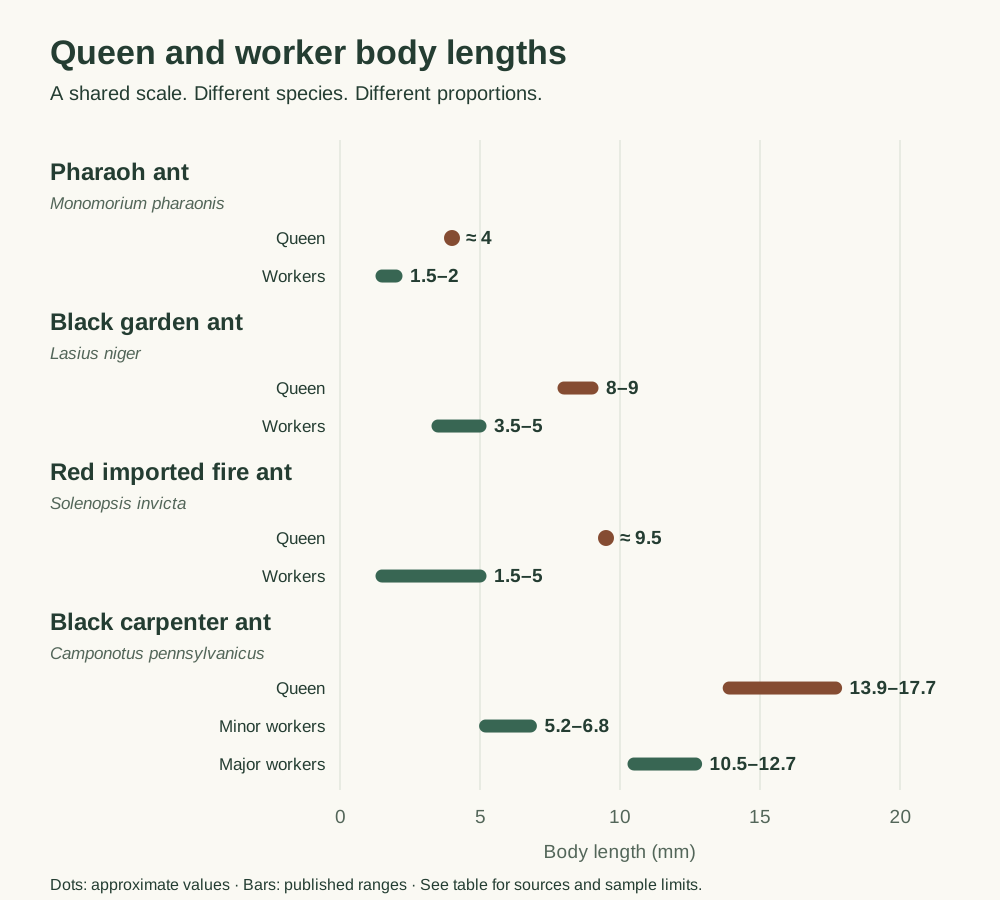
Published queen and worker lengths for four ant species on a shared 0–20 mm axis. Dots mark approximate single values; bars mark reported ranges. Carpenter ant ranges come from small museum samples, not complete species limits.
Queen ant size compared with a worker ant
When people ask how big a queen is compared with a “regular ant,” they usually mean a worker. The size difference depends on the species—and which worker you choose.
Black carpenter ants have small minor workers and much larger major workers. A queen can therefore look enormous beside a minor worker but much closer in size to a major worker. Neither comparison establishes a rule for other ants.
Comparing different species is even less useful for identification. The table shows that a major black carpenter worker can be longer than a pharaoh ant queen.
When possible, compare ants of the same species. Consider the shape of the middle body alongside length, rather than deciding that the largest ant must be the queen.
A closer look
A queen among her workers
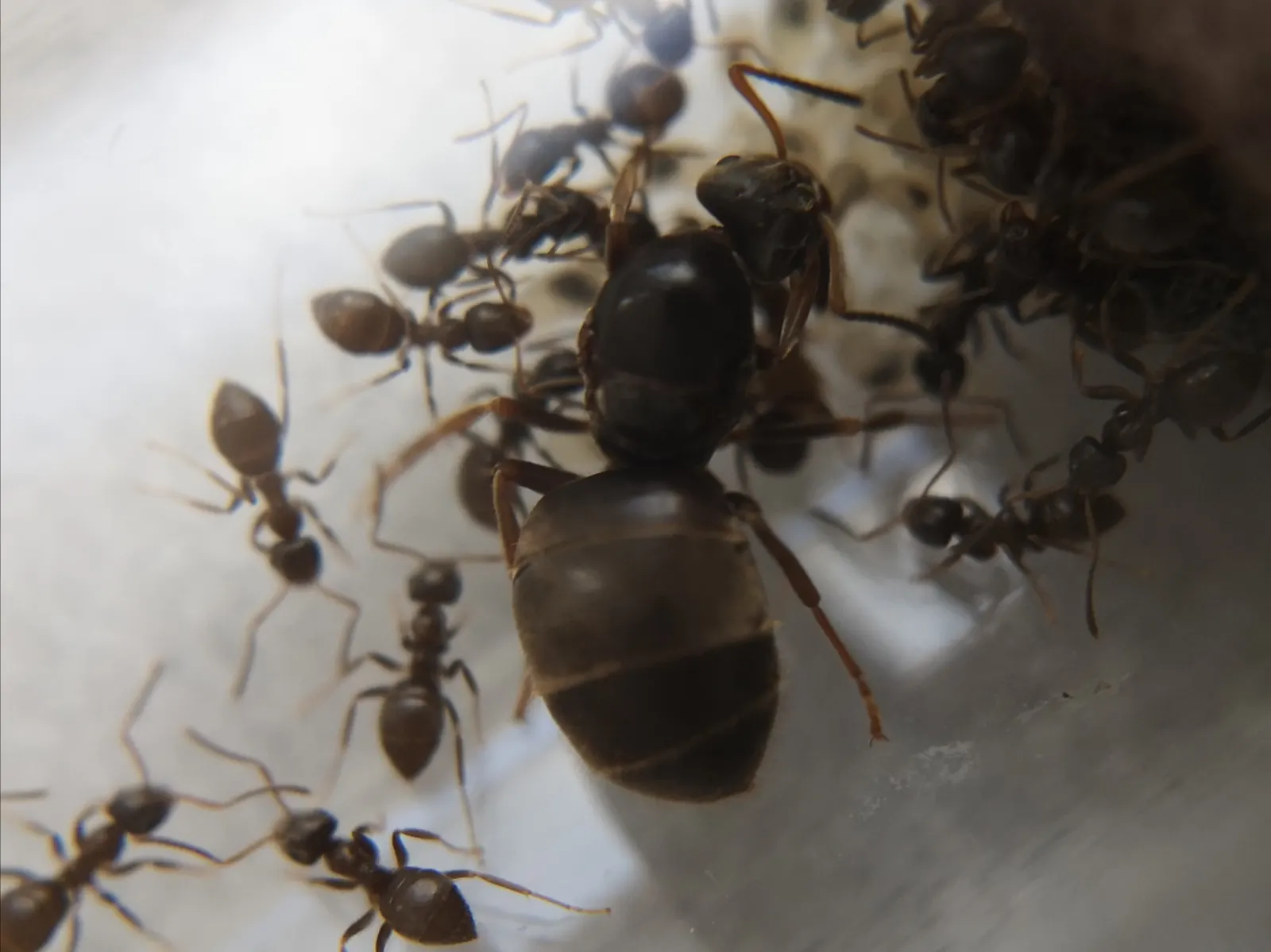
A black garden ant queen (Lasius niger) surrounded by workers and brood. Identified by the photographer; this shared scene shows relative size, not a measured queen-to-worker ratio.
Photo: Jason BergerCC BY-SA 4.0 · Resized and re-encoded; uncropped.
What does a queen ant look like?
A queen’s middle body can be more informative than her length.
In species with winged queens, this section—the mesosoma—contains the structures associated with flight. Workers have a different arrangement adapted to their tasks on the ground. The distinction involves anatomy, not simply a larger version of the same body. Research on queen and worker anatomy
Use several features together:
Scroll sideways to see all columns.
| Feature | What to look for | What it cannot tell you |
|---|---|---|
| Middle body, or mesosoma | A developed flight-bearing middle section in species with winged queens | A single shape shared by every queen species |
| Wings or attachment marks | Wings, or visible attachment points after wings have been shed | Whether the ant has mated; wings alone also do not distinguish queens from males |
| Rear body, or gaster | A supporting comparison with workers of the same species | Whether an ant is a queen from this feature alone |
| Overall length | A match with documented measurements and an appropriate worker comparison | Species identity or reproductive status by itself |
Shed wings do not prove mating. Experiments with Argentine ants have documented virgin queens shedding their wings. Wing attachment marks can help interpret an ant’s form, but they are not a fertility test. Research on wing shedding in virgin queens
A photograph can help when the species, viewing angle, and scale are known. An unidentified ant photographed without a size reference gives you much less to work with.
A closer look
The queen’s middle body
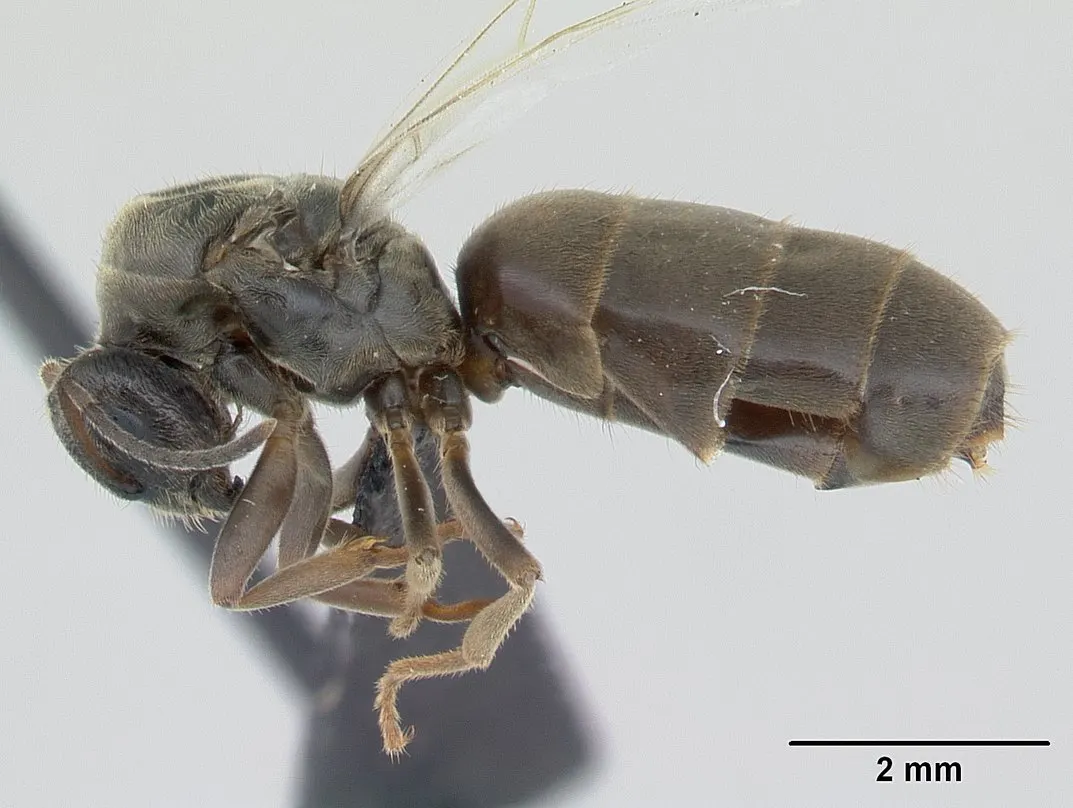
Black garden ant queen specimen CASENT0178773, photographed by April Nobile for AntWeb. The original 2 mm scale bar is retained. The bent head and preserved posture make this an anatomy reference, not a direct measurement of a living queen.
Photo: April Nobile / AntWeb.orgCC BY 4.0 · Resized and re-encoded; uncropped.How to estimate an ant’s size
For a rough measurement, a clear photograph with a millimeter reference is more useful than comparing the ant with a fingertip or recalling how large it looked.
- Include a millimeter reference. Position it as close as practical to the same plane as the ant.
- Choose a clear view. The whole body should be visible and reasonably straight.
- Measure the body. For this practical estimate, use the front of the head to the tip of the gaster. Exclude projecting antennae, mandibles, legs, and wings.
- Keep the result approximate. Camera angle, body position, and distance from the reference can change the apparent length.
This method is for an everyday estimate. It does not reproduce every scientific source’s measurement procedure. Avoid disturbing a nest or moving ants together just to obtain a comparison.
A closer look
Where body length begins and ends
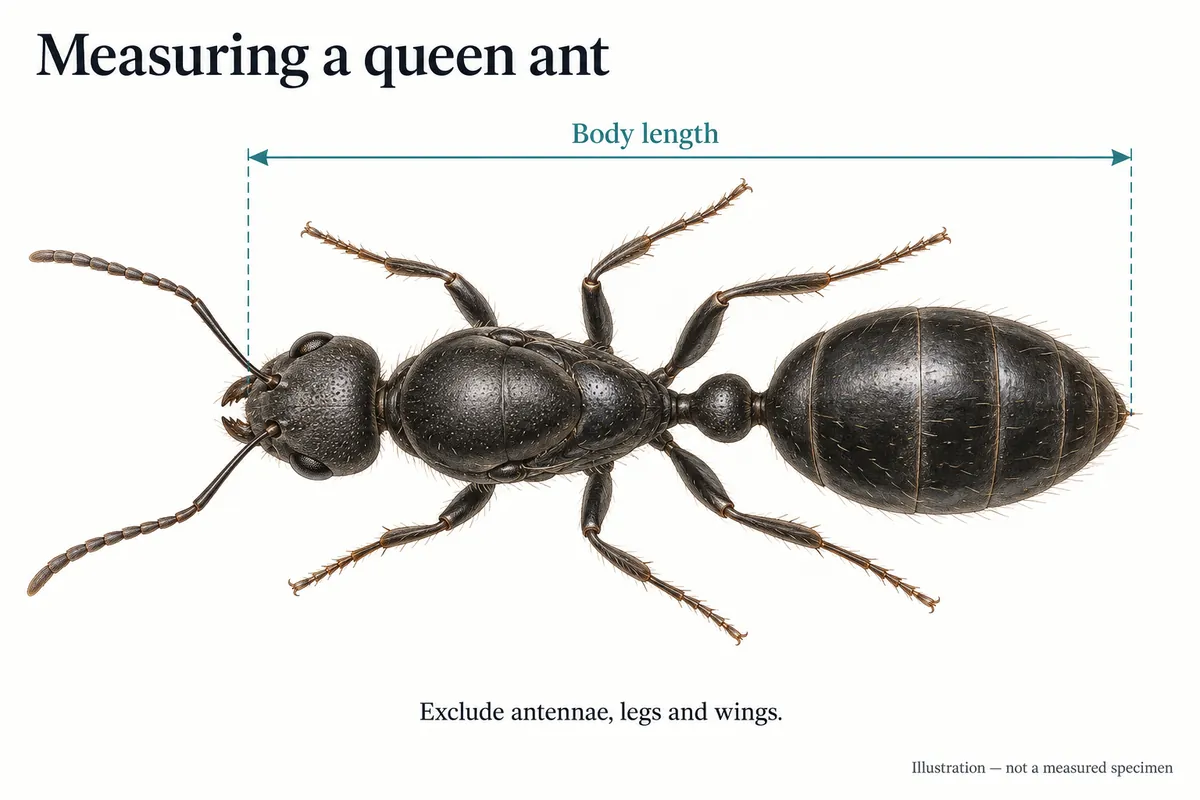
General illustration of the head-to-gaster endpoints used for a rough body-length estimate. Exclude projecting antennae, mandibles, legs and wings. This is not a measured specimen or a species-identification reference.
Common questions about queen ant size
What is the largest queen ant?
Among living ants, Guinness World Records lists the wingless queen of the fulvous driver ant, Dorylus fulvus, as the largest ant, with a recorded maximum length of 5 cm—50 mm, or about 2 inches. This is an exceptional record, not a typical queen-ant size. Guinness World Records
Body condition also matters when comparing very large queens. Army-ant queens can develop strongly swollen egg-laying abdomens, a condition called physogastry. A measurement that includes this expanded abdomen should be distinguished from one taken when the abdomen is contracted; body length is not simply a measure of a larger head and thorax. Research discussing army-ant queen physogastry
If extinct ants are included, Guinness lists queens of the fossil species Titanomyrma giganteum at approximately 6 cm (2.4 inches) long. That is a separate fossil record, rather than an ant living today. Guinness: largest fossil ant species
Can a queen ant be small?
Yes. A pharaoh ant queen is only about 4 mm long, even though she is larger than her own workers. A queen does not need to be a large ant compared with other species. University of Florida
Is the largest ant always the queen?
No. Some species have large major workers, and comparisons across species can be misleading. Use length alongside body structure and a reliable species reference.
Can a queen ant have no wings?
Yes. Many queens shed their wings, while some species have naturally wingless queen forms. The absence of wings alone does not distinguish a queen from a worker or establish whether she has mated. Queen morphology research
For the next part of the story, read how an ant becomes a queen. If you are preparing a founding setup, identify the species and its needs before following our ant test tube setup guide.
Further reading
Sources and review notes
EveryAnt prioritizes peer-reviewed, university, museum and government sources. Internal source checks do not replace independent specialist review.
- Pharaoh ant — Monomorium pharaonisUniversity of Florida IFAS · Accessed 2026-10-14
- Lasius niger: species accountCollingwood (1979), Fauna Entomologica Scandinavica / Zenodo · Accessed 2026-10-14
- Red imported fire antTexas A&M AgriLife Extension · Accessed 2026-10-14
- Camponotus pennsylvanicus — specimen measurementsMississippi Entomological Museum · Accessed 2026-10-15
Small museum samples: six queens, six minor workers and five major workers. These are not complete species limits.
- Evolution of thorax architecture in ant castes highlights trade-off between flight and ground behaviorsKeller, Peeters and Beldade (2014), eLife · Accessed 2026-10-14
- Dealation in virgin females of the Argentine antPsyche · Accessed 2026-10-14
- Largest ant: Dorylus fulvus queenGuinness World Records · Accessed 2026-10-15
- Army-ant queen physogastry and reproductionInsectes Sociaux · Accessed 2026-10-14
- Largest ant species ever: Titanomyrma giganteumGuinness World Records · Accessed 2026-10-15