
Reproduction, not command
The word queen carries a great deal of unhelpful baggage. She issues no instructions, and the colony’s behaviour emerges from workers responding to local cues rather than from anything she decides.
Her role is reproductive and it is genuinely central: in most species she is the only individual who can produce new workers, which makes her the constraint on everything the colony can become.
Recognising one
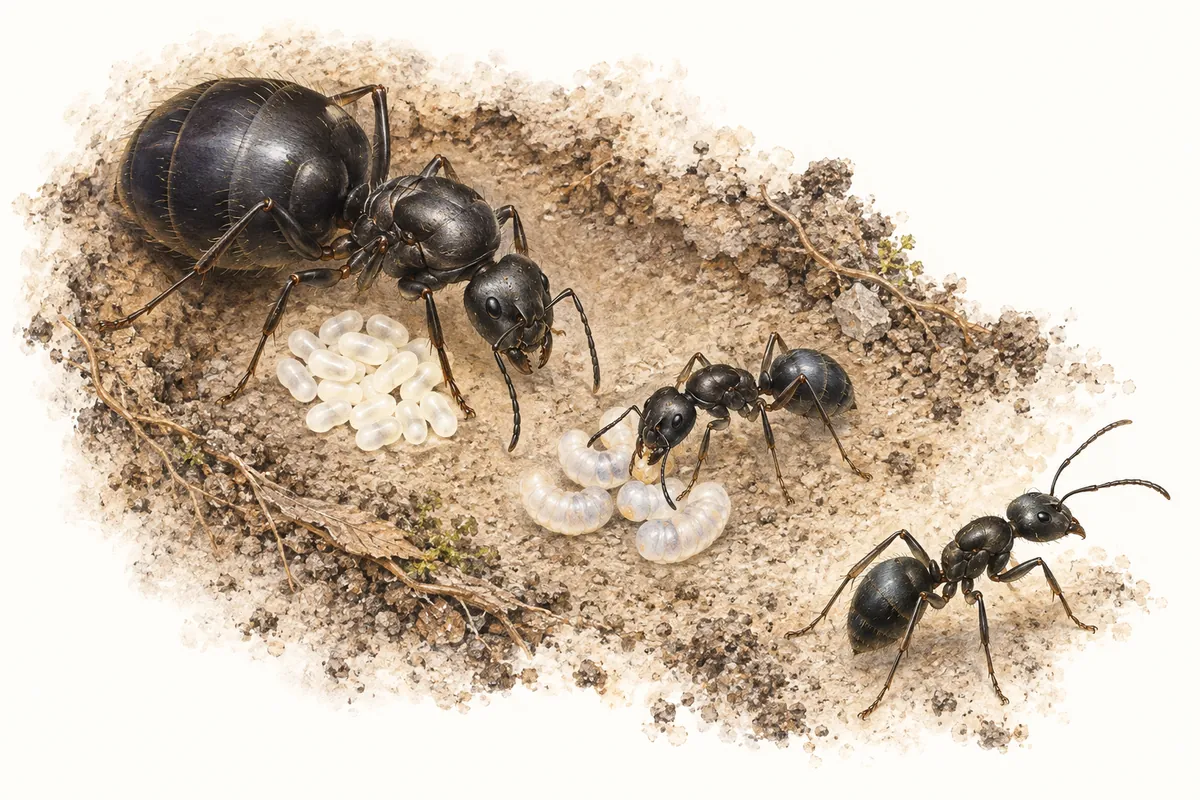
Within a colony she is normally the largest ant, commonly one and a half to two times worker length. Across species that comparison falls apart entirely, which is why size on its own identifies nothing.
The structural marks are better: a deep mesosoma built to carry flight muscle, scars where wings were shed after mating, and an enlarged gaster. The size and appearance guide covers what to look at and what gets mistaken for a queen.
Where a queen comes from
Queens and workers are female castes with different developmental pathways. They need not be full sisters or genetically identical. Nutrition, temperature, whether a queen is already present, and in some species genotype can influence development, acting together rather than as a single switch.
The caste guide sets out why there is no ant equivalent of royal jelly, and why an explanation that holds for one species can be untrue for the next.
When a colony loses her
A single-queen colony that loses its queen usually cannot replace her, because workers in most species never mated and can only lay unfertilised eggs, which become males. The colony continues for a while and then runs down.
Measured recovery rates are lower than intuition suggests, and the brood gives it away long before the worker numbers do. The queen-death guide covers what the evidence shows.
One queen or many
Some species keep exactly one queen, some tolerate several, and some maintain many across connected nests. That single trait changes what queen loss means, how colonies found, and how large a population can become.
It is the reason general answers about queens need a species attached before they mean much.
Keeping a queen
For anyone starting a colony, the founding stage is where a queen is most vulnerable and most demanding of restraint. The founding guide covers the standard test-tube setup, when not to feed her, and why most attempts fail.
Collecting or buying live queens is regulated in many places. Check local rules before taking one from the wild or ordering one.
Further reading
Sources and review notes
EveryAnt prioritizes peer-reviewed, university, museum and government sources. Internal source checks do not replace independent specialist review.
- Lasius niger — appearance and natural-history referencesAntWiki · Accessed 2026-09-22
Visual inspiration for this generated illustration; not a verification of species identity. The teaching explanation remains general and conditional.
- Ant coloniesAustralian Museum · Accessed 2026-09-05
- Quantifying the Effect of Colony Size and Food Distribution on Harvester Ant ForagingPLOS ONE / PubMed Central · Accessed 2026-09-05
- Caste development and evolution in ants: it’s all about sizeJournal of Experimental Biology 220 (Trible & Kronauer, 2017) · Accessed 2026-09-21
Review treating morphological caste as a function of body size, which supports both the caste-determination account and the limits of recognising a queen by size alone.