
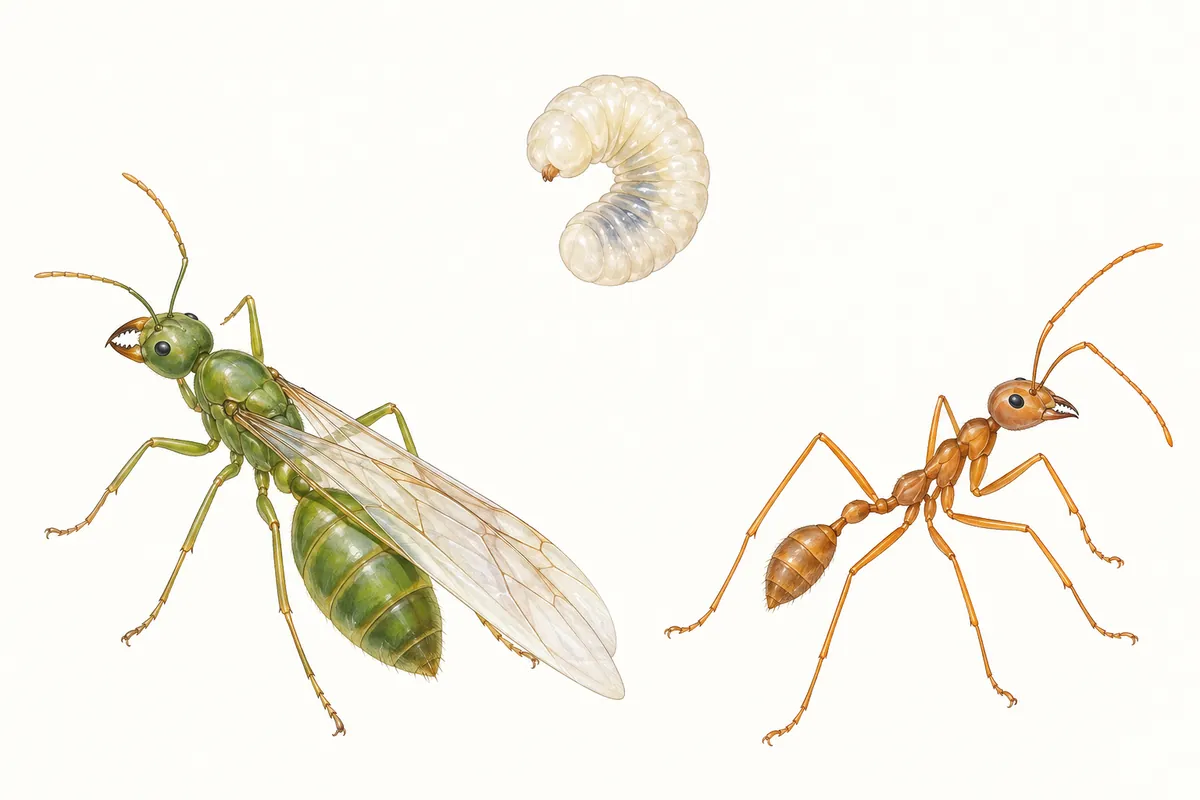
The decision happens before adulthood
Queens and workers are female castes with different developmental pathways. They are not necessarily full sisters or genetically identical. In many species, environmental influences on larval development help produce a winged reproductive or a wingless worker; in others, genotype also influences the outcome.
That decision is made during the larval stage and is effectively final. An adult worker does not become a queen later, and an adult queen cannot revert. Whatever determines caste has to act while the larva is still growing.
Food is the most reliable lever
Across many species the strongest single influence is nutrition — how much a larva is fed, for how long, and what the food contains. Well-fed larvae grow larger and cross developmental thresholds that poorly fed larvae never reach.
This is why caste and body size are so tightly linked. Trible and Kronauer argue that morphological caste in ants is largely a function of size, with the machinery that builds a queen switching on above a threshold that a small larva never passes.
Not the honey-bee story
Most people arrive at this question having heard about royal jelly. In honey bees, a specific glandular food reliably produces a queen, and the story is satisfyingly simple.
Ants do not work that way, and borrowing the explanation actively misleads. There is no ant equivalent of royal jelly — no single substance that makes a queen. The inputs are more varied, more interacting, and considerably less tidy.
Temperature and season matter
Larvae developing at different temperatures can follow different paths, and in temperate species the timing within the colony’s year matters as well. A larva overwintering before it completes development is in a different situation from one raised straight through in summer.
This is part of why queen production is seasonal in many species rather than continuous. The colony is not deciding to make queens so much as conditions arriving in which queens become possible.
The queen’s own presence is a signal
A laying queen suppresses the production of new queens in many species. Her presence is communicated chemically through the colony, and while she is producing that signal, larvae that might otherwise develop as queens develop as workers instead.
Remove her and the suppression lifts. That is one reason queen loss is sometimes followed by a burst of attempted queen rearing — though as the companion page on queen death sets out, rearing a queen and producing a mated one are not the same achievement.
Genotype contributes in some species
The environmental picture above was for a long time treated as the whole explanation. Schwander and colleagues reviewed the evidence and found genetic contributions to caste in a growing number of species — cases where a larva’s own genotype biases which path she takes, independently of how she is fed.
The proportion varies enormously. In some ants the genetic contribution is negligible; in others it is substantial and well documented. Treating either extreme as the general rule misrepresents the group.
How many queens a colony ends up with
A related question is how many queens a mature colony keeps. Many species keep exactly one. Others tolerate several, and some maintain large numbers across connected nests.
That number is a species-level trait rather than a developmental outcome, and it changes what caste determination is for. In a single-queen species, queen production is about founding new colonies elsewhere. In a many-queen species, some of those queens may simply be added to the colony they were reared in.
Queens and workers are different builds
The result of the queen pathway is not just a bigger worker. A queen is built for a different job: a thorax carrying flight muscle, wings that are shed after mating, and a body capable of sustained egg production over years.
A worker is built for the work the colony needs done now. Recognising that difference is the subject of the size and appearance guide, and it is a more reliable route to identifying a queen than size alone.
What this cannot tell you
Caste determination is an active research area and the balance of inputs has been worked out in detail for relatively few species.
- A larva cannot be identified as a future queen by eye; the pathway is not visible until development is well advanced.
- Feeding a larva more does not make a queen in a species where genotype dominates.
- Honey-bee explanations do not transfer, however familiar they sound.
- Findings from a well-studied species should not be assumed to hold across the family.
Further reading
Sources and review notes
EveryAnt prioritizes peer-reviewed, university, museum and government sources. Internal source checks do not replace independent specialist review.
- Oecophylla smaragdina — caste appearance and colour variationAntWiki · Accessed 2026-09-22
Visual inspiration for this generated illustration; not a verification of species identity. The teaching explanation remains general and conditional.
- Nature versus nurture in social insect caste differentiationTrends in Ecology & Evolution (Schwander, Lo, Beekman, Oldroyd & Keller, 2010) · Accessed 2026-09-21
Review establishing that caste is not determined by one universal mechanism: environmental and genetic contributions vary across species, so honey-bee framing does not transfer to ants.
- Caste development and evolution in ants: it’s all about sizeJournal of Experimental Biology 220 (Trible & Kronauer, 2017) · Accessed 2026-09-21
Review treating morphological caste as a function of body size, which supports both the caste-determination account and the limits of recognising a queen by size alone.
- Ant coloniesAustralian Museum · Accessed 2026-09-05