
Choosing test tubes for ants
A useful ant test tube is transparent, clean, undamaged and large enough for its occupants. The important measurements are its diameter and length—and the space remaining after the reservoir and cotton are installed.
There is no single size proven best for every species. A USDA laboratory manual describes 15 × 125 mm and 16 × 150 mm tubes for founding imported fire-ant colonies. These are documented examples, not universal recommendations for other ants. USDA rearing methods
Commercial options also vary. AntsCanada specifies 17 × 150 mm plastic tubes for its founding system. That confirms glass is not the only material used, but does not establish that one product performs better than another. Manufacturer specifications
Scroll sideways to see all columns.
| Feature | What to check | Why it matters |
|---|---|---|
| Diameter and length | Compare published dimensions with species-specific care guidance. Documented examples include 16 × 150 mm laboratory tubes and 17 × 150 mm commercial tubes. | A size used successfully for one species is a starting reference, not a guarantee for every queen. |
| Usable chamber space | Allow room for the queen to move and tend brood after installing the reservoir and both cotton plugs. | The tube’s full length is not the available nesting space. |
| Material and condition | Choose clean glass or a suitable plastic tube. Reject chipped glass, cracks, sharp edges and containers with unknown chemical residues. | Material alone does not determine suitability; condition and previous use matter too. |
| Cotton fit | The reservoir plug must hold water back while its chamber-facing surface remains damp. The entrance plug must prevent escape while allowing ventilation. | The two plugs perform different jobs. |
| Connections | Check the actual tube and adapter specifications, including whether measurements describe internal or external diameter. | Similar-looking tubes do not necessarily fit the same outworld or connector. |
| Cleaning and replacement | Follow the material’s cleaning instructions and keep a spare tube available. | Some plastics deform in hot water; AntsCanada specifically warns against dishwasher cleaning for its tubes. |
Choosing a tube is also a good moment to identify the queen. Her size alone does not establish her species or founding requirements. Our queen-ant guide explains the broader biology.
What you need
Prepare the equipment before moving any ants. The basic materials are simple; the arrangement and maintenance matter more than decorative accessories. AntScout setup guide
Use plain water in the nesting reservoir. Offer food separately when needed, where leftovers can be removed.
- A suitable test tube, plus a spare.
- Clean drinking water.
- Plain, unscented cotton wool without added lotions.
- A clean, blunt tool for positioning cotton.
- An opaque, removable sleeve or cover.
- A stable support that prevents the tube rolling.
- A secure feeding area if the queen’s founding strategy or the colony’s stage requires one.
How to build an ant test tube setup
These steps describe a basic cotton-and-water arrangement. Confirm that it suits the species before introducing a queen.
- Inspect and prepare the tube. Check for damage and contamination. Clean it appropriately for its material, rinse thoroughly and leave no cleaning residue.
- Add the water reservoir. Roughly one third of the tube is a practical starting arrangement, leaving space for cotton and the living chamber. It is not an exact requirement: published fire-ant research also used half-filled tubes. Tschinkel’s founding methods
- Fit the retaining cotton. Push a snug plug down to the water. It should separate the reservoir from the chamber while maintaining a damp surface facing the ants.
- Check the empty setup. Rest it horizontally in its support and watch for leakage. The chamber should contain air, with no accumulating puddle. Rebuild a leaking setup before putting ants inside.
- Introduce the queen and secure the entrance. Work within an escape-resistant container. Avoid gripping her body or shaking her into place. Fit a separate dry cotton entrance plug; do not substitute an airtight lid.
- Cover and position the tube. Shade the living chamber without blocking ventilation. Keep it stable, away from direct sunlight, radiators and repeated vibration.
The two-plug arrangement—a water-retaining plug and a separate entrance plug—is documented in experimental founding nests. It does not, by itself, establish suitable temperature, feeding or seasonal care for every species. Founding study
A closer look
A small space for a fragile beginning.
A fully claustral founding example. Establish the species’ feeding needs before using this arrangement.
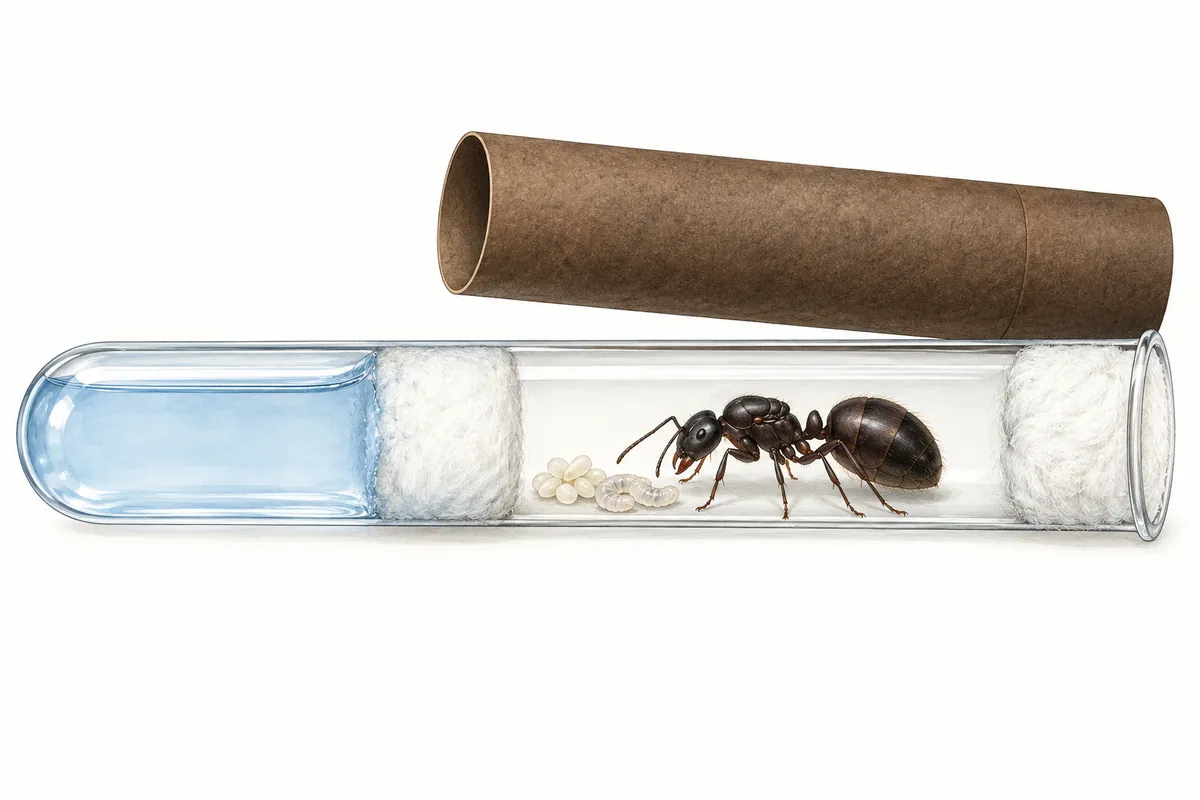
A founding tube for a fully claustral queen: water reservoir, retaining cotton, living chamber and breathable entrance plug. The darkness sleeve is lifted away to reveal the arrangement. AI-generated illustration; not to scale and not a universal care protocol.
Water reservoir (closed end)
Water is held behind the retaining cotton. The queen and brood occupy air space, not the reservoir.
Retaining cotton (damp inner face)
Cotton separates the water from the living chamber. The chamber-facing surface is damp, with no pooled water around the queen.
Living chamber (queen and brood)
The dry air space contains the queen and her first brood. Their drawn size does not specify an appropriate tube diameter.
Entrance plug (breathable cotton)
A separate dry cotton plug retains the ants while allowing air exchange. Do not replace it with an airtight cap.
Darkness cover (shown withdrawn)
An opaque removable sleeve shades the living chamber. It is lifted away here only to reveal the arrangement.
The darkness sleeve is shown withdrawn and lifted away so the chamber is visible; in use it shades the living space and must not block ventilation. The carpenter-ant-inspired queen is not a species identification. Fully claustral queens use stored reserves during founding; semi-claustral queens require access to appropriate food. The drawing is not a universal care protocol or scale plan.
Does a queen ant need feeding in a test tube?
The answer depends on how she founds a colony.
Fully claustral queens can produce their first workers using stored reserves, without leaving the founding chamber to forage. Semi-claustral queens forage during founding and need suitable food before workers appear. Founding strategies vary between species; some also vary with circumstances. Brown and Bonhoeffer’s review
“Fully claustral” does not mean feeding is biologically impossible or always harmful. It describes the capacity to found without foraging. Follow reliable guidance for the identified species rather than applying a blanket “never feed a queen” rule.
For a semi-claustral queen, arrange secure feeding access from the beginning. A plugged tube with no access to food is not a complete setup for her.
Laboratory survival times are not feeding intervals. Our guide to how long ants can live without food or water explains the distinction.
Once workers appear, provide species-appropriate food. For many commonly kept omnivorous ants, this includes a carbohydrate source and suitable insect food. Begin with small, accessible portions, avoid large exposed liquid drops and remove leftovers before they spoil. There is no dependable “one insect per five workers” formula. Practical early-colony guidance
Diet research also needs careful interpretation. An experiment with developing Lasius niger colonies found differences between particular carbohydrate and protein sources; its authors explicitly caution against extending the results to every ant species. Diet study
A closer look
Three situations, different feeding needs
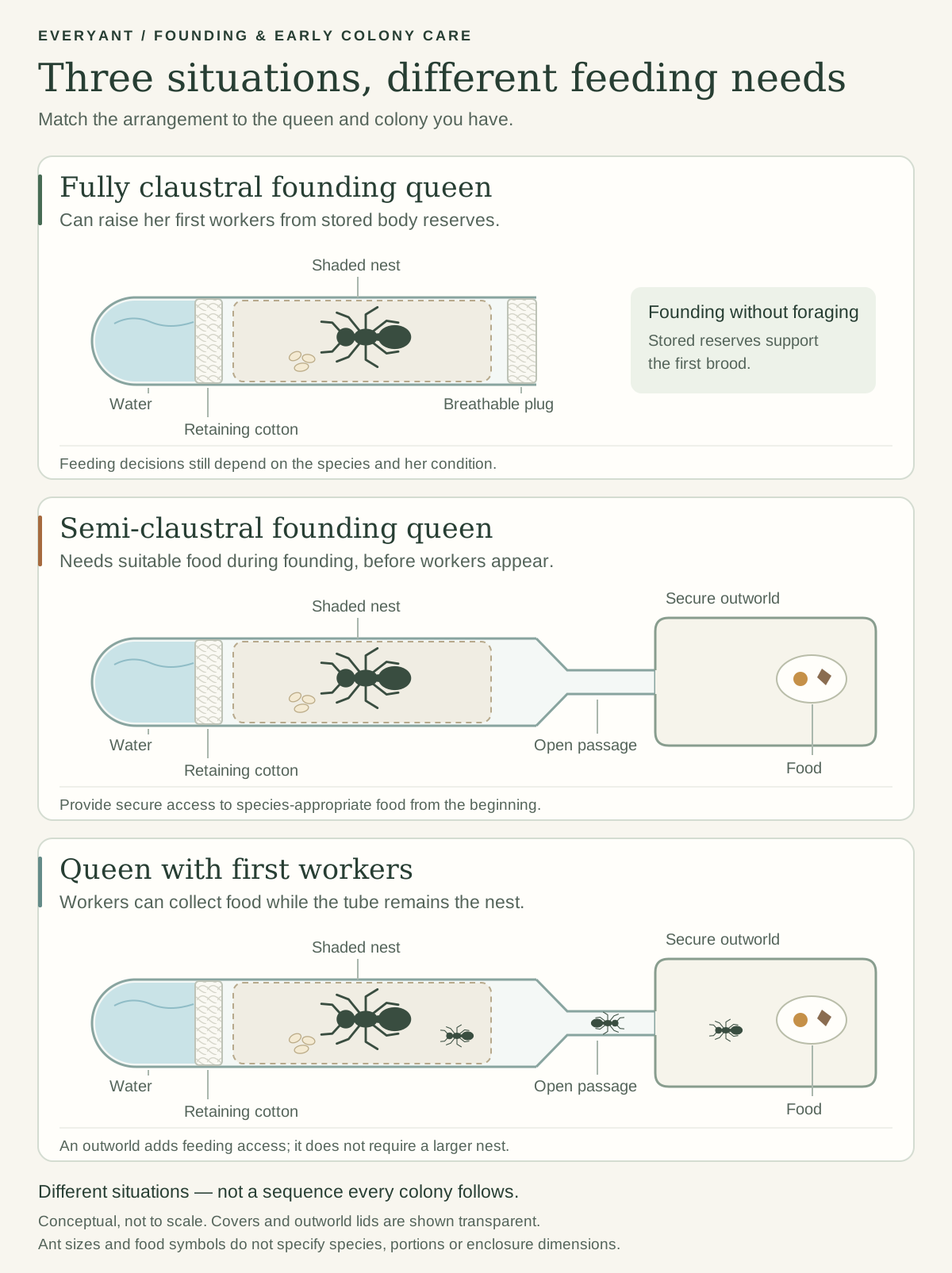
Match the arrangement to the queen’s founding strategy and the colony’s stage. These are three different situations, not stages every colony passes through. Conceptual diagram; not to scale. Covers and outworld lids are shown transparent; ant sizes and food symbols do not specify species, portions or enclosure dimensions.
Common test-tube problems and what to do
Inspect with a purpose: check hydration, containment, food and the condition of the living chamber. Avoid repeatedly handling the tube simply to check for new eggs.
The table gives practical checks, not diagnoses based on appearance alone.
Scroll sideways to see all columns.
| Observation | What it may mean | Appropriate response |
|---|---|---|
| Water is pooling around ants or brood | The retaining plug may be leaking or displaced; substantial condensation can also collect. | Treat accumulating water as urgent. Prepare a sound replacement and arrange a safe transfer promptly. Do not wait indefinitely for voluntary movement if ants are at immediate risk. |
| Reservoir is nearly empty or cotton is drying | The tube is losing its water supply. | Offer a prepared replacement before hydration fails. Avoid trying to refill through the occupied chamber or pushing its retaining plug. |
| Droplets appear on the wall | Condensation can follow temperature changes. | Check for sunlight, nearby heat and pooling. Droplets alone do not identify a mould problem or prove the whole setup needs replacing. |
| Food remains uneaten | The portion may be excessive, unsuitable or no longer wanted. | Remove leftovers and adjust the next offering. Make feeding access easier instead of repeatedly reaching past the queen and brood. |
| Cotton darkens or visible growth spreads | Staining, debris or microbial growth may be involved; colour alone cannot establish the cause or danger. | Assess the whole setup. Offer fresh accommodation if growth spreads into occupied space or conditions deteriorate; seek experienced help if the ants appear affected. |
| Workers escape during feeding | Access or containment is becoming difficult to manage. | Use a small, secure outworld and check every opening and connection. This need not mean the colony requires a larger nest. |
A replacement tube should be ready before it becomes necessary. The AntsCanada care guide describes connecting fresh accommodation and allowing the colony to relocate; that is useful for routine moves, provided the existing conditions remain safe. Transfer guidance
When to replace the tube or add an outworld
Replacing a tube, adding a feeding area and enlarging the nest solve different problems.
Replace the tube when its water supply or condition requires it. Provide a secure, ventilated route to fresh accommodation and avoid using heat or flooding to drive the ants out.
Add an outworld when feeding and cleaning become difficult inside the tube—or earlier if the queen needs to forage. The tube can remain the nest while workers collect food from the adjoining enclosure. Tube-and-outworld arrangement
Consider a larger nest when the species and colony genuinely need one. A fixed worker count cannot account for differences in ant size, brood volume and tube dimensions. Our colony-size guide explains why colony populations vary so widely.
Can a test tube be a formicarium?
Yes. A test tube formicarium uses the tube as an artificial nest. It can house a suitable founding queen or young colony, while an attached outworld provides space for feeding and waste.
The useful question is whether the arrangement continues to meet the ants’ needs. If it provides appropriate moisture, secure nesting space and manageable feeding access, the arrival of the first workers does not automatically make it obsolete.
For the wider choice of enclosures, read our guide to ant farms and formicaria.
Further reading
Sources and review notes
EveryAnt prioritizes peer-reviewed, university, museum and government sources. Internal source checks do not replace independent specialist review.
- Techniques for collecting, rearing, and handling imported fire antsBanks and colleagues (1981), USDA · Accessed 2026-10-15
Tube dimensions are examples from imported fire-ant laboratory methods, not universal size recommendations.
- Basic AC Test Tube Pack — specifications and cleaningAntsCanada · Accessed 2026-10-15
Manufacturer specifications support dimensions, material and cleaning restrictions, not comparative performance claims.
- Ant Test Tube Setup Guide for BeginnersAntScout · Accessed 2026-10-15
Practical keeper guidance, distinguished from experimental evidence.
- Resource allocation, brood production and cannibalism during colony founding in the fire ant, Solenopsis invictaTschinkel (1993), Behavioral Ecology and Sociobiology · Accessed 2026-10-15
Methods, printed page 210, support a water reservoir and two cotton plugs. They do not establish a universal reservoir fraction or care protocol.
- On the evolution of claustral colony founding in antsBrown and Bonhoeffer (2003), Evolutionary Ecology Research · Accessed 2026-10-15
Supports distinctions and variation in founding strategies.
- Comparison of the simplest diets to find the most effective one in developing ant colonies of Lasius nigerScientific Reports · Accessed 2026-10-15
Species-specific diet comparisons; not a universal portion size or all-species feeding prescription.
- Starting Your Ant ColonyAntsCanada · Accessed 2026-10-15
Practical source for tube transfers and outworld access. No fixed worker threshold or heat-forced transfer is endorsed here.