
What have experiments actually measured?
The comparison below uses the same study and experimental setup throughout. The opening answer is based on these observations. Pedraza and colleagues
Scroll sideways to see all columns.
| Ant studied | Experimental condition | Approximate time when survival reached 50% | Source |
|---|---|---|---|
| Platythyrea punctata workers | No food; water available | About 8 days | Figure 2A |
| Cardiocondyla obscurior workers | No food; water available | About 10 days | Figure 2B |
| Platythyrea punctata workers | Neither food nor water | About 2 days | Figure 2A |
| Cardiocondyla obscurior workers | Neither food nor water | About 2 days | Figure 2B |
These are rounded readings of the published graphs, using the new-setup curves—not exact author-reported medians. Researchers tested groups of three nurse workers, with 30 workers per species per condition, under a 22–26°C cycle and 75% relative humidity. Study methods
At 50% survival, approximately half remained alive. This describes neither the first death nor the longest survivor. Small worker groups also cannot represent every member of a complete colony.
Why does access to water change the answer?
Starvation concerns a lack of food. Desiccation means drying out. An ant deprived of both food and water faces both problems, so “without food” and “without food or water” are different questions.
Surrounding humidity matters, too. An ant without an accessible water source in very dry air faces different conditions from one in a humid nest. Humidity describes water vapor in the air; it does not tell you whether an ant has water it can drink.
A study of fire ants examined water loss and survival at 30°C and just 0–2% relative humidity. Under those extremely dry conditions, tolerance differed among species and worker sizes. Larger workers generally endured desiccation longer than smaller workers. Those results describe a particular laboratory exposure, not an ordinary household or underground nest. Fire-ant water-loss study
Before trusting a survival figure, check what “without water” meant: no drinking source, dry surroundings, or both. A number without its conditions can be misleading.
A closer look
Food + water. Water only. Neither available.
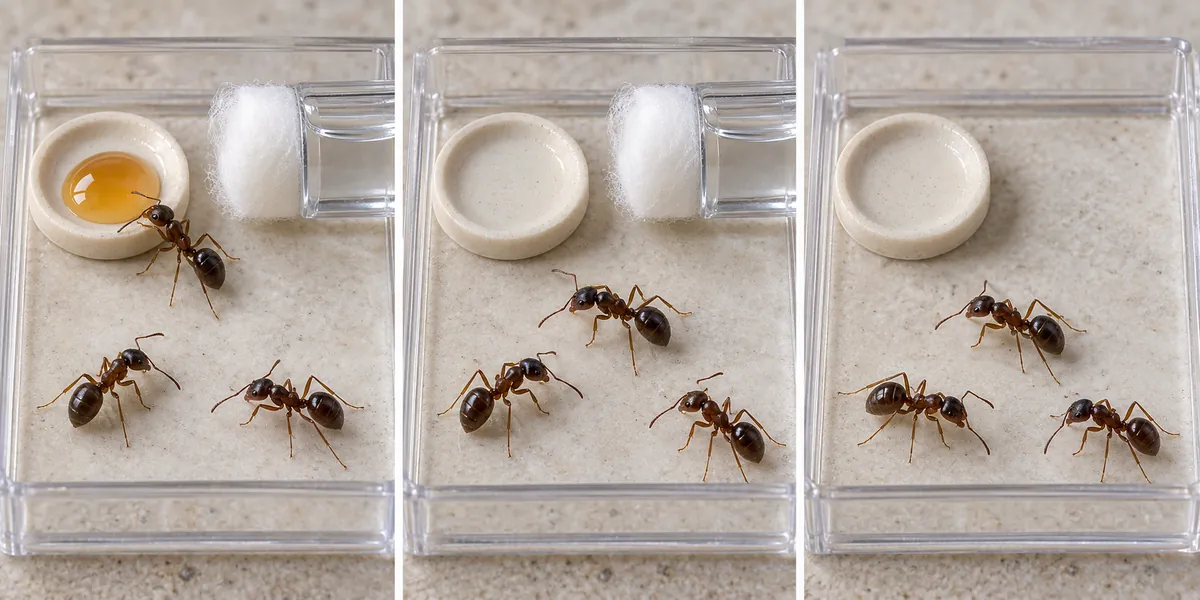
Three resource conditions used to explain survival experiments. AI-generated conceptual illustration, not photographs of the study, identified experimental species or instructions for a home experiment. The panels do not predict an individual ant’s lifespan.
Why doesn’t every ant survive for the same time?
Species, size and surroundings
“How long can an ant live without food?” sounds like a question about one animal, but the answer requires more information. Which species? Which worker size? What temperature and moisture conditions?
The fire-ant research illustrates why these details belong beside any survival estimate. Even workers grouped under the familiar name “fire ants” did not respond identically to drying conditions. A result from one species and size class should not become a rule for all ants. Fire-ant study
Stored food and food sharing
An ant that has stopped collecting food may still have food inside its body. The crop is a storage compartment in the digestive tract. In ants that share liquid food, workers can pass crop contents mouth-to-mouth through a behavior called trophallaxis.
Research tracking food movement within colonies shows how these exchanges help distribute incoming food. However, food sharing redistributes a resource; it does not create an unlimited supply. Nor does seeing an ant away from food tell you when it last ate. Greenwald and colleagues
Our guides to internal ant anatomy and colony biology explain how individual organs and colony interactions fit together.
Whether the ant is alone
Social conditions can also change survival, but there is no simple rule that a group always withstands starvation better.
In research on Camponotus fellah, isolated workers had shorter lives than workers kept in groups when food was provided. The researchers also found differences in activity and how ingested food was handled. Crucially, the lifespan difference between isolated and grouped workers disappeared when food was withheld. Koto and colleagues
That makes isolation part of the experimental context—not a universal multiplier you can apply to a starvation estimate.
Can a queen ant survive without feeding?
Some queens can raise their first workers without leaving their founding chamber to collect food.
This is fully claustral founding. The queen uses stored body reserves to support herself and the developing brood. In semi-claustral founding, a queen leaves the chamber to forage during this early stage. These are different biological strategies, not interchangeable care instructions. Brown and Bonhoeffer
A founding queen using reserves therefore should not be treated as equivalent to a worker suddenly deprived of food. Her strategy also does not establish one fasting duration for every queen.
Before deciding whether a captive queen needs feeding, identify her species and founding strategy. Food requirements and suitable moisture must be considered separately; “she does not forage during founding” does not mean “she needs no water.”
For the practical arrangement, see our ant test-tube setup guide.
A closer look
Water access and feeding are separate questions
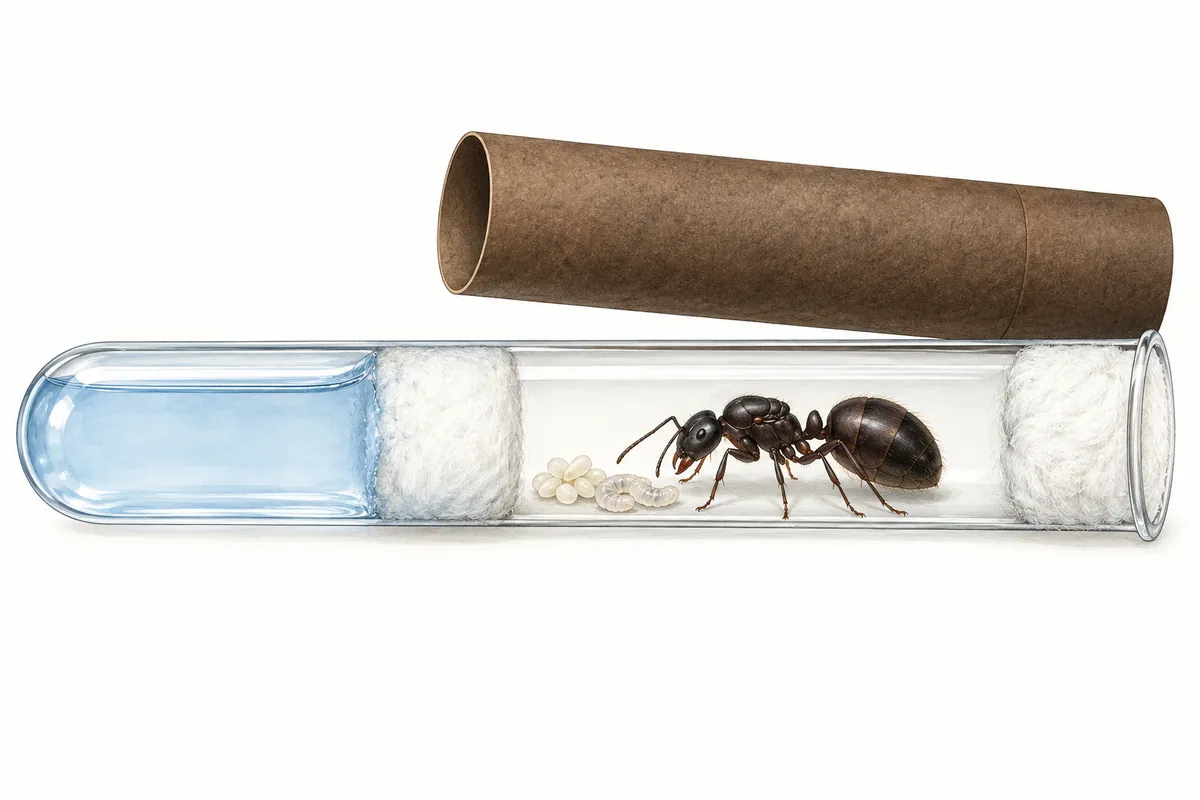
An illustrated founding-tube setup. Water access and feeding requirements are separate questions; a queen’s feeding needs depend on her founding strategy.
What does this mean for ants you keep?
A survival experiment asks what happens under a defined treatment. Keeping ants asks how to maintain suitable conditions. Those purposes lead to different decisions: the point at which half an experimental group has died cannot serve as a care schedule.
Use a short maintenance checklist:
- Check water access. Confirm that the supply has not dried out and that the ants can reach it. Water visible somewhere in an enclosure is not necessarily accessible.
- Match feeding to the species and stage. A founding queen, a colony with workers and a seed-harvesting species should not automatically receive identical care.
- Arrange care during absences. Leave clear instructions for checking the established setup and providing appropriate food. Do not calculate an unattended period from a laboratory survival figure.
- Observe without testing deprivation. Record feeding and maintenance observations during normal care rather than withholding resources to find a limit.
These steps are practical care recommendations, not a feeding interval derived from the comparison table. For setup and early-colony maintenance, use the test-tube guide alongside reliable guidance for the identified species.
Further reading
Sources and review notes
EveryAnt prioritizes peer-reviewed, university, museum and government sources. Internal source checks do not replace independent specialist review.
- A new experimental setup for studying ants and similar-sized insectsPedraza, Heinze, Dussutour and Bernadou, Insectes Sociaux (2023) · Accessed 2026-10-17
Table times are rounded visual readings of the new-setup survival curves in Figure 2, not exact author-reported medians. Small nurse-worker groups, not complete colonies.
- Comparative Cutaneous Water Loss and Desiccation Tolerance of Four Solenopsis spp. (Hymenoptera: Formicidae) in the Southeastern United StatesInsects (2020) · Accessed 2026-10-17
Desiccation experiments at 30°C and 0–2% relative humidity. These conditions do not represent ordinary household or nest conditions.
- Individual crop loads provide local control for collective food intake in ant coloniesGreenwald, Baltiansky and Feinerman, eLife (2018) · Accessed 2026-10-17
Food sharing and crop storage; not evidence for a universal starvation duration.
- Social isolation causes mortality by disrupting energy homeostasis in antsKoto, Mersch, Hollis and Keller, Behavioral Ecology and Sociobiology (2015) · Accessed 2026-10-17
The abstract reports that the lifespan difference between isolated and grouped Camponotus fellah disappeared when food was withheld.
- On the evolution of claustral colony-founding in antsBrown and Bonhoeffer, Evolutionary Ecology Research (2003) · Accessed 2026-10-17
Distinguishes founding strategies; not a universal fasting duration or moisture prescription.