
Where should you look for a queen ant?
Start by observing local ant activity without disturbing nests. During a reproductive event, winged ants may gather near a colony entrance before departing. Afterward, some queens search the ground for places to establish nests. Arizona State University
Accessible paths and other open surfaces can make individual ants easier to see. Researchers in Texas collected newly mated fire-ant queens walking on sidewalks and parking areas after flights. That is a documented example of where queens were visible—not proof that every species uses those surfaces, or a recommendation to collect fire ants. Calkins and colleagues
Look from the surface. Opening nests or lifting paving to find an established queen is unnecessary for this approach.
Scroll sideways to see all columns.
| What you observe | What it can tell you | What it cannot establish / next step | Source |
|---|---|---|---|
| Winged ants gathering at a nest entrance | A reproductive departure may be approaching. | They may not yet have mated. Watch rather than collecting from the entrance. | ASU |
| An individual queen walking after a local flight | She may be searching for a founding site. | Walking alone does not confirm mating or future colony success. | ASU |
| A substantial middle body region associated with flight muscles | Body structure helps distinguish many queens from workers. | Shape varies. Compare several features with reliable identification references. | Keller and colleagues |
| A queen that has shed her wings | She has passed through wing loss, called dealation. | Wing loss alone does not prove mating; unmated fire-ant queens can shed wings. | Calkins and colleagues |
| Warm, relatively calm weather during a local flight season | Conditions may favor flights in some populations. | Weather does not guarantee a flight. The supporting UK study predominantly sampled Lasius niger. | Hart and colleagues |
When is the best time to find a queen ant?
A useful answer needs both a species and a place.
In Arizona, some ants begin new nests during spring, while others respond to summer monsoon rains. Those contrasting patterns occur within one region; neither supplies a calendar for the whole United States. Arizona State University
In Britain, black garden ants, Lasius niger, most often fly from early July to mid-August, commonly on warm summer afternoons. This is a regional species account, not a date range for every black ant. BWARS
A three-year UK study also found that local weather mattered: higher temperatures and lower wind speeds were associated with winged-ant sightings. Its findings do not establish universal temperature or wind thresholds for queen collecting. Hart and colleagues
Use regional species information to choose when to watch, then record what actually happens nearby. Our ant nuptial-flight guide explains mating flights and compares further timing examples.
How can you recognize a queen ant?
Look beyond overall size. In many familiar species, a queen’s middle body region is built to accommodate flight muscles and differs from that of a worker. However, queens themselves vary: research documents different thoracic proportions associated with different founding strategies. A single rounded silhouette cannot identify every queen. Keller and colleagues
Take clear photographs from above and from the side without restraining the ant. Compare body structure with a reliable reference for the suspected species. Our queen ant size guide provides measurements and worker comparisons.
Wings alone are insufficient because mating flights include males as well as young queens. Likewise, losing wings does not certify mating: researchers observed unmated fire-ant queens shedding them under queenless experimental conditions. Australian Museum, Calkins and colleagues
Keep three questions separate: Is this a queen? Which species is it? Has she mated? A photograph may help answer the first two without resolving the third.
A closer look
A queen on the ground
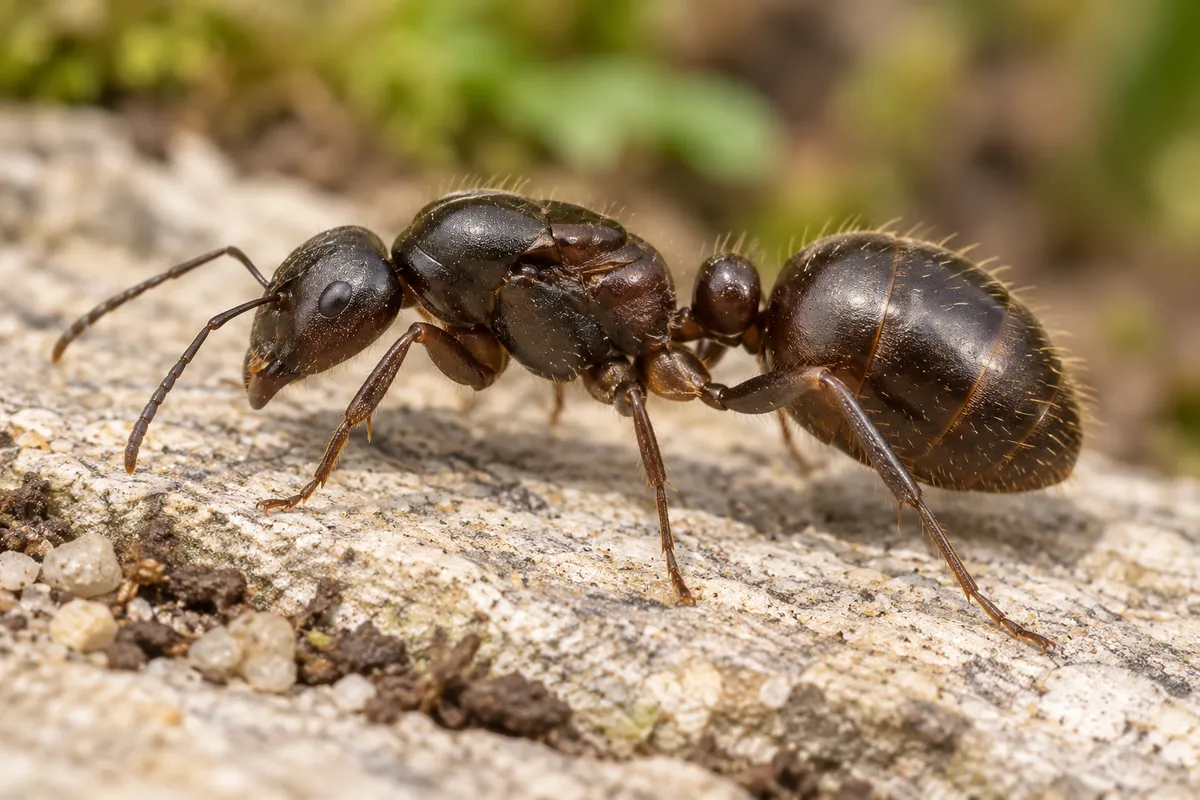
A representative wingless queen ant on exposed ground. AI-generated illustration, inspired by black garden ants; not a verified species specimen or confirmation of mating.
Before collecting: check permission and prepare
Check permission to collect at the location, including landowner, protected-area and species rules. Being allowed to walk somewhere does not automatically permit removing wildlife. The US National Park Service, for example, prohibits collecting in its units without the applicable research and collecting permit. NPS
Local collection and transporting ants across borders are different questions. USDA APHIS states that importing ants or moving them between US states requires a valid PPQ 526 permit. Its guidance on local collecting does not override site-specific restrictions. Outside the United States, consult the relevant local authority. USDA APHIS
Prepare a clean, secure collection container, a soft brush, a label and suitable housing before collecting. If you cannot establish permission, identity or appropriate care, photograph the ant and leave her undisturbed.
How to catch a queen ant carefully
For a suitable queen where collection is permitted, use a container-first approach with minimal direct handling:
- Position the container. Place its opening near the ant’s path without trapping her legs beneath the rim. Allow her to walk inside when possible.
- Guide gently if needed. A soft brush with slightly moistened bristles can help move an ant. Do not pinch her body or pull her legs or wings.
- Secure her before moving. Check that she is fully inside and clear of the closure. Use suitable escape-resistant containment with ventilation.
- Keep the container shaded and stable. Avoid direct sun, hot vehicles and unnecessary shaking. Temporary collection containers are not long-term housing.
- Label the observation. Record the date, location, habitat and whether you saw nearby flight activity. Keep photographs with those notes.
Stanford’s ant-investigation teaching guide supports vial collection, recording collection locations and using a moistened paintbrush to move ants. It concerns classroom ant handling rather than a tested queen-founding protocol; the steps above are practical handling guidance, not a guarantee of survival. Stanford teaching guide
A closer look
Approach. Guide. Secure.
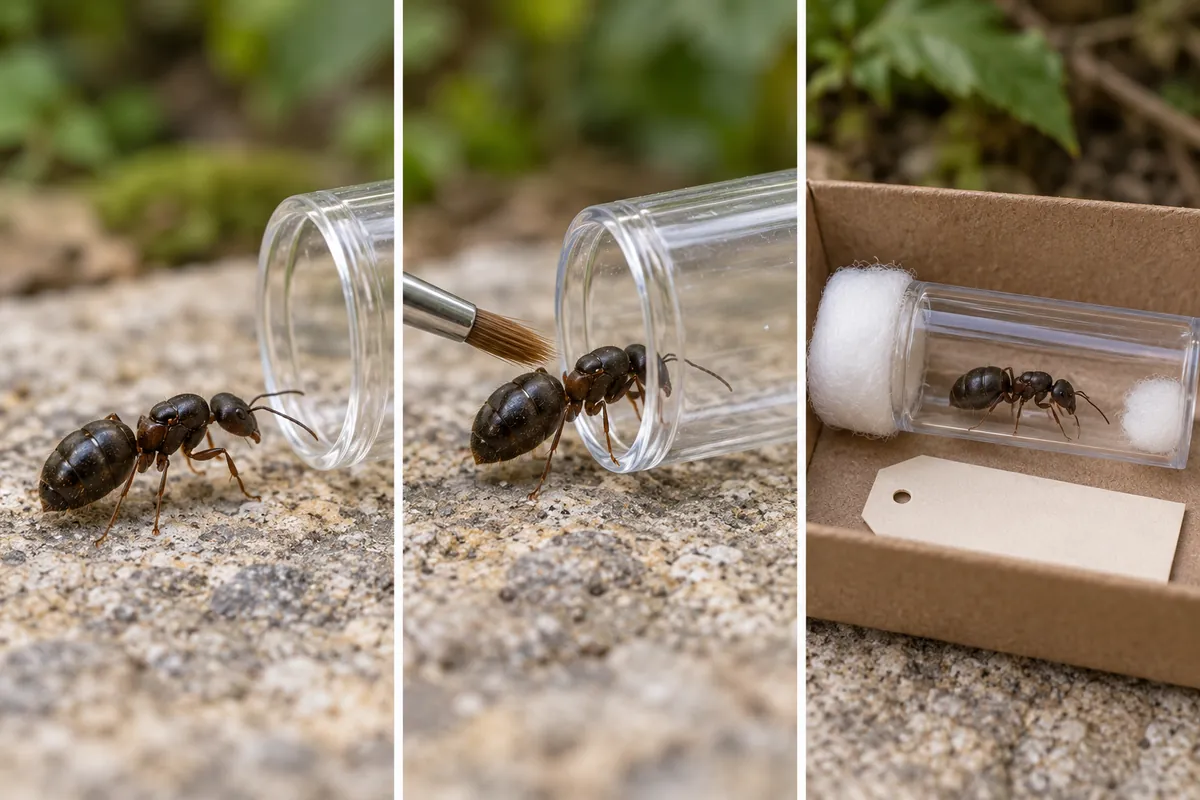
Illustrated collection sequence for a suitable queen where collection is permitted. AI-generated representative handling scenes, not photographs of a documented collection. The final panel shows temporary containment, not a permanent nest.
What should you do after finding one?
Identify the species and its founding strategy before deciding when to feed.
Fully claustral queens can raise their first brood using stored reserves without foraging. Semi-claustral queens forage during founding and need appropriate food. A closed tube without feeding access therefore cannot be assumed suitable for every queen. Brown and Bonhoeffer
Our ant test-tube setup guide explains housing, water reservoirs, feeding access and maintenance. Finding a queen does not guarantee successful founding, and independent founding is only one of the strategies ants use. Australian Museum
Before the next observation, check:
- Have I recorded the location, date and conditions?
- Did I distinguish flight activity from ordinary worker traffic?
- Do my photographs support identification?
- Is collection permitted, and can I provide appropriate care?
If you find no queen, keep the observations. A dated record of local activity is more useful than assuming every warm day should produce a flight.
Further reading
Sources and review notes
EveryAnt prioritizes peer-reviewed, university, museum and government sources. Internal source checks do not replace independent specialist review.
- Collecting Queen AntsArizona State University Ask A Biologist · Accessed 2026-10-17
Used for timing and observation; this guide does not adopt its nest-excavation, direct gripping or bulk-collection advice.
- Lasius niger — flight period in BritainBWARS / M. G. Fox · Accessed 2026-10-17
Regional species account, not a universal queen-finding calendar.
- The spatial distribution and environmental triggers of ant mating flightsHart and colleagues (2018), Ecography · Accessed 2026-10-17
UK citizen-science observations predominantly sampled Lasius niger; weather associations are not universal thresholds.
- Evolution of thorax architecture in ant castes highlights trade-off between flight and ground behaviorsKeller, Peeters and Beldade (2014), eLife · Accessed 2026-10-17
Queen-worker morphology and variation among queens; generated artwork is not a diagnostic specimen.
- Brain gene expression analyses in virgin and mated queens of fire ants reveal mating-independent and socially regulated changesCalkins and colleagues (2018), Ecology and Evolution · Accessed 2026-10-17
Texas collection observations and experimentally induced wing loss in virgin queens; not a recommendation to collect fire ants.
- Ant Investigation: Field Test VersionStanford University CSET (2014) · Accessed 2026-10-17
Classroom ant collection and gentle brush handling; not a queen-specific founding trial or a success-rate estimate.
- Ant coloniesAustralian Museum · Accessed 2026-10-17
Reproductive roles and different colony-founding strategies.
- On the evolution of claustral colony founding in antsBrown and Bonhoeffer (2003), Evolutionary Ecology Research · Accessed 2026-10-17
Distinguishes founding from stored reserves from founding with foraging.
- Invertebrate Pets — A Message to Ant Keepers, Importers, and SellersUSDA APHIS · Accessed 2026-10-17
US import and interstate-movement requirements; local collection remains subject to site and species restrictions.
- Research Policy and GuidanceUS National Park Service · Accessed 2026-10-17
Collection restrictions within NPS units.