
Decide what experience you are buying
A slim sand habitat with shipped workers is a short observation activity. A formicarium intended for a queen and developing colony is a long-term animal-care system. Both may be called an ant farm, but their requirements and useful lifetimes are different.
Set expectations before comparing products. Children need adult supervision, and a long-lived colony requires ongoing feeding, hydration, seasonal knowledge and a plan for expansion.
Match the nest to the ants
Species differ in worker size, humidity needs, colony growth, stinging risk and ability to escape. A gap harmless for a large harvester ant may be an open door for a tiny household species.
A responsible seller should name the ants, explain legal shipping limits and state whether a queen is included. Never release purchased or non-native ants. If local identification and rules are unclear, pause the purchase.
Evaluate the life-support basics
Look for controllable hydration without flooding, adequate ventilation, a dark or coverable nest area and an accessible foraging space. Feeding should not require opening the primary nest over an uncontained surface.
The system should make condensation, mold, waste and dead workers visible enough to manage. Gel may provide dramatic tunnels for a short display, but marketing claims should not be confused with evidence of suitability for a growing colony.
Escape resistance and maintenance
Ask how lids lock, ports close and tubing connects. Product dimensions should include the smallest gap, not only the external size. Expansion ports need secure plugs before they are needed.
Cleaning instructions should be realistic without dismantling an occupied nest. Replacement parts, hydration access and a safe way to move the colony matter more over time than decorative lighting.
A defensible comparison method
EveryAnt’s future comparison will separate measured facts, researched suitability and hands-on observations. It should record internal dimensions, gap tests, hydration behavior, ventilation, visibility, setup time, maintenance, expansion and failure modes.
Ratings will remain unpublished until products have been obtained without editorial conditions and tested under the same documented protocol. Merchant availability and affiliate relationships will be stored separately from conclusions.
Know the four common habitat formats
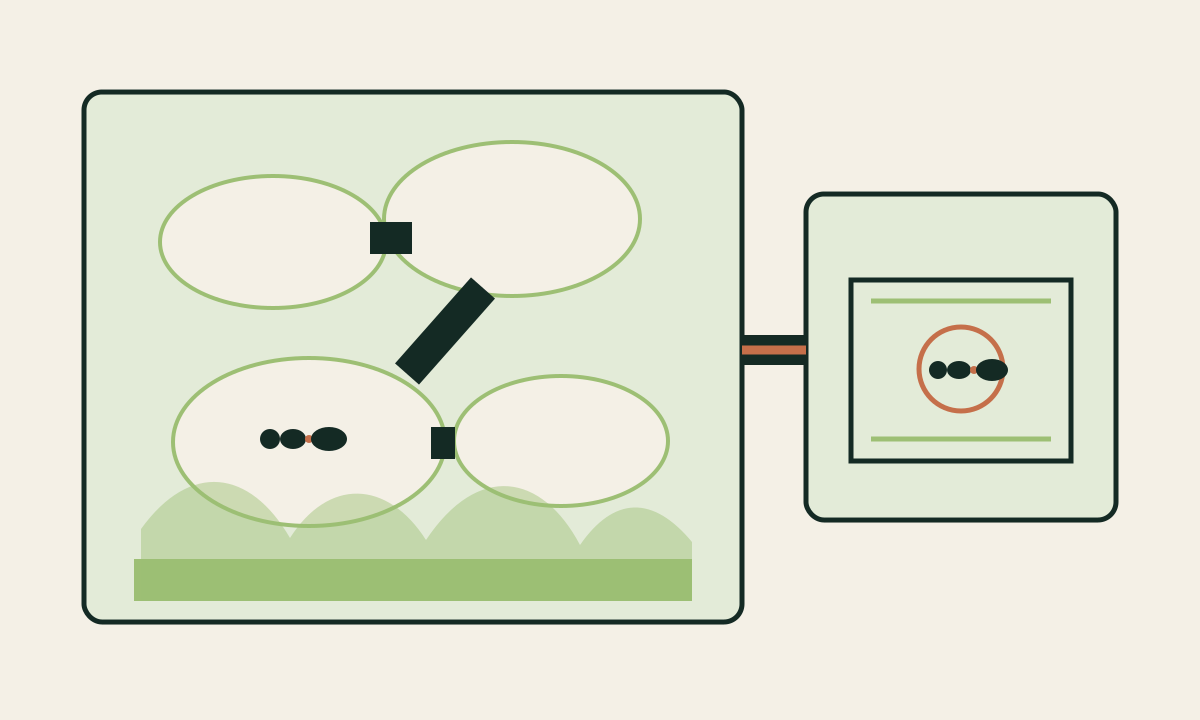
A narrow sand or soil sandwich makes tunneling visible but offers little room and can be difficult to hydrate evenly. A gel habitat is usually sold as a short observation novelty rather than a complete long-term system. Modular formicaria use manufactured chambers connected to a foraging arena, while naturalistic setups place soil, plants or décor in a larger enclosure.
No format is automatically best. A classroom activity with worker ants has different goals from maintaining a queenright colony for years. Visibility, containment and easy setup favor one design; behavioral choice, expansion and husbandry control may favor another. Decide which trade-off you are buying before comparing window colors.
A queenright colony changes the time scale
Workers collected without a queen cannot found a self-sustaining colony, so the display has a natural endpoint. A fertilized queen with brood may begin slowly and then produce increasing numbers of workers. The habitat must support today’s small colony without becoming an oversized, difficult-to-regulate space—and offer a safe expansion route later.
Growth is not guaranteed. Founding queens and young colonies can fail even with careful husbandry, and species differ in development and seasonal needs. A responsible setup treats the animals as a living colony, not a desktop animation that can be restarted by shaking the screen.
Hydration is a system, not an accessory
Ants need access to water, while brood and nest chambers often require a species-appropriate humidity gradient. Too little moisture can desiccate a colony; too much can flood chambers, encourage mold and remove the choice between wetter and drier areas.
Look for a reservoir or hydration point that can be refilled without opening the occupied nest. Ask how water spreads, how the level is checked and what happens if the unit is overfilled. Marketing phrases such as “self-sustaining” should not replace maintenance instructions. Water remains stubbornly physical even when the packaging is very optimistic.
Containment must match the smallest worker
External dimensions tell you almost nothing about escape resistance. Inspect ventilation mesh, lid corners, cable or tubing ports, joints and the gap created when a feeding door opens. Minor workers can fit through spaces that appear decorative rather than structural to us.
A secondary containment tray and a clear procedure for feeding reduce the consequences of a mistake. Barriers wear or become contaminated and should not be the only line of defense. Avoid species with significant stinging risk in a child-focused setting, and place every habitat where it cannot be knocked over or overheated by direct sun.
The foraging arena is where care actually happens
Food should be placed and removed in an arena without opening the nest chambers. The keeper needs room to use tools, collect waste and observe uneaten food while preventing escapes. Smooth access matters more than a dramatic nest façade because feeding and cleaning happen repeatedly.
Look for removable dishes, secure access and surfaces that reveal small workers. The nest itself should have an opaque cover so the colony can remain dark between observations. Permanent exposure to room light may improve the view for people while removing the retreat the ants would choose.
Check the law before live ants enter the cart
Rules depend on country, region and species. In the United States, USDA APHIS states that all ant species are regulated for interstate movement; moving, importing or selling ants across state lines requires the appropriate authorization, and a seller’s claim should be verified for the species and destination. State rules may add further limits.
Do not release purchased or transported ants. Confirm the scientific name, origin and permitted destination before ordering, and keep the records. A habitat advertised globally does not make its occupants globally shippable. The plastic box crosses borders more easily than the colony, which is an important difference to discover before checkout.
A practical pre-purchase scorecard
Reject a kit that cannot name its intended ant size, explain hydration, provide ventilation details or describe secure feeding. Give extra credit for replaceable parts, expansion ports, a dark cover, measured gap information and clear failure instructions. Treat bundled ants as a separate regulated and welfare decision from the habitat itself.
For a child or classroom, define who performs daily checks, who handles escapes and what happens during holidays. For long-term keeping, budget for food, replacement barriers, expansion and species-specific seasonal care. The best first purchase may be a simple empty setup plus time spent learning about a locally appropriate species.
- Purpose: short observation or long-term queenright colony.
- Biology: named species, worker size and moisture needs.
- Engineering: refillable hydration, ventilation and measured gaps.
- Care: secure arena access, waste removal and darkness cover.
- Future: expansion path, replacement parts and end-of-life plan.
- Evidence: no “best” label without comparable hands-on testing.
Sources and review notes
EveryAnt prioritizes peer-reviewed, university, museum and government sources. These pages have completed an internal source and scope pass; independent subject-matter review remains recommended before a production launch.
- Ant Farm Activity Packet — Arizona State University Ask A Biologist. Accessed 2026-09-05.
- Invertebrate Pets — USDA Animal and Plant Health Inspection Service. Accessed 2026-09-05.