
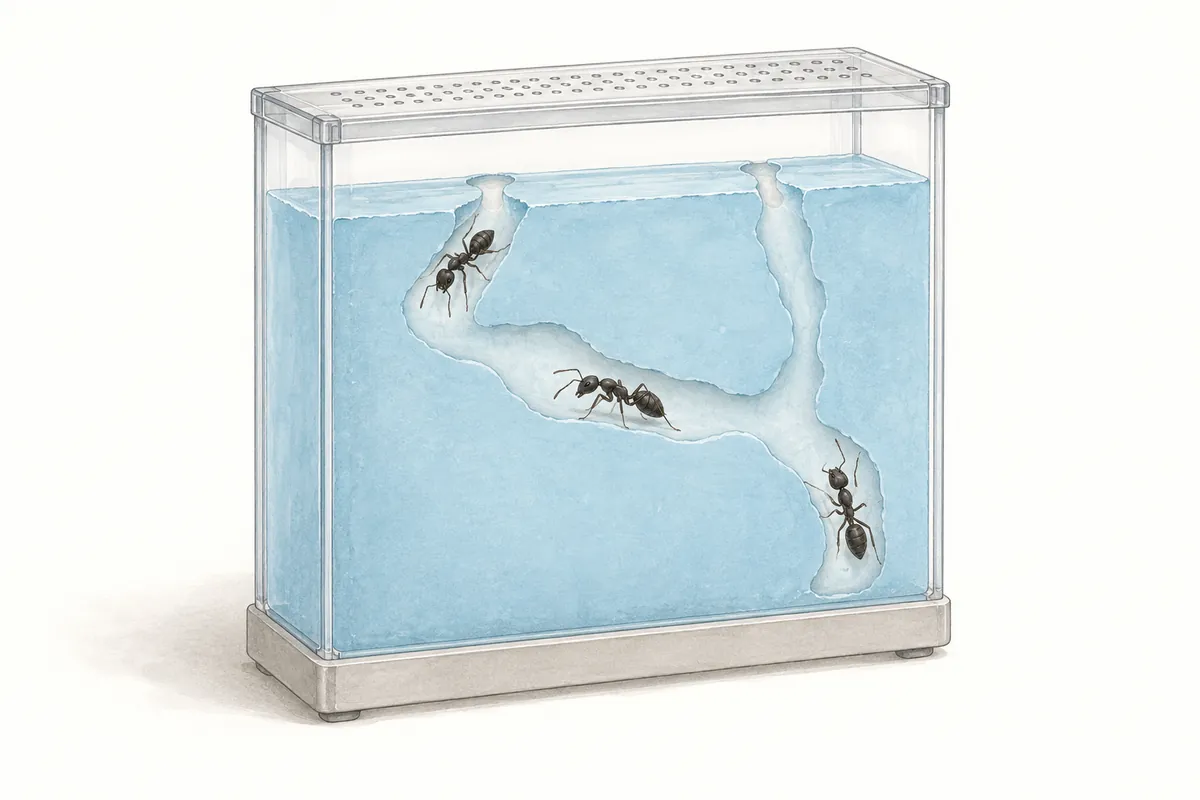
Where the idea came from
Gel habitats trace back to a short-duration spaceflight experiment. A nutrient gel let researchers observe tunnelling in microgravity without loose sand drifting around a sealed container, and without needing to feed or water the animals during the flight.
That was the design brief: a small number of workers, observed for days, in conditions where conventional husbandry was impossible. It was a clever solution to a specific problem. It was never an argument that gel is how ants should be housed on a shelf at home.
What the gel is asked to do
In a consumer kit the gel has three jobs at once. It is the structure the ants tunnel through, the entire water supply, and the entire food supply. Nothing else goes in.
Combining all three into one medium is what makes the product simple, and it is also where the difficulty sits. Each of those roles has different requirements, and a single substance optimised for transparency and firmness is unlikely to be optimal as a diet.
Nutrition is the weak point
Ant colonies do not eat one thing. Reviews of ant nutrient regulation describe colonies balancing carbohydrate against protein, with demand shifting by caste, by life stage and by what the brood needs at the time. Workers frequently need sugars; growing larvae generally need protein.
Feeding trials make the same point from the other direction. Work comparing simple diets in developing Lasius niger colonies found real differences in outcome between them, and USDA testing of several artificial diets for laboratory fire-ant colonies found colonies failing to grow on them. A uniform gel is a simple diet by definition, and simple diets have a poor record.
A sealed box is a difficult environment
The other recurring problem is what happens inside a closed transparent container over time. A moist nutrient medium at room temperature is a good substrate for mould, and a manufacturer manual for a consumer gel colony devotes attention to exactly that, along with condensation and the handling of dead ants.
Ants in a natural nest deal with this by moving refuse away from brood and by adjusting which chambers they use. In a sealed gel block there is nowhere to move it to.
Most kits have no queen
This is the point that decides the question. Gel kits are typically sold with worker ants only, and often with no ants at all — the buyer sends off for a tube of workers separately.
A group of workers without a queen is not a colony. It cannot produce replacements, so its numbers only fall, and the workers supplied are already adults of unknown age. Whatever the gel does or does not do, a worker-only kit has a fixed and fairly short lifespan built into it from the start.
What they are genuinely good for
There is a real use case. For a short classroom or family observation — a couple of weeks, worker ants only, the goal being to watch tunnelling behaviour rather than to keep a colony — a gel kit does what it says. The tunnels are unusually visible, nothing needs feeding, and there is no substrate to spill.
Judged as that, it is a reasonable object. The mismatch arises when a product designed for short observation is bought as a home for a colony someone intends to keep.
What to use instead for a real colony
A colony you mean to keep needs the three functions separated: a nest chamber that stays dark and humid, a connected outer area where food and refuse can go, and hydration you control and can replenish.
For a founding queen, the standard starting point is not a display habitat at all but a test tube with a water reservoir — dark, humid, disturbance-free and nearly free. The companion guide covers how to set one up and what to feed once the first workers appear.
Reading the packaging
Marketing copy for these kits tends to lean on the spaceflight association and on the self-contained design. Both are accurate as history and as description; neither is evidence about long-term colony survival, and the distinction is worth holding on to.
If a kit claims a colony will thrive for months, the useful question is what that claim rests on. Published husbandry evidence for gel as a complete diet is what would settle it, and it is not what is being offered.
What this cannot tell you
This page assesses a habitat type, not any particular product, and gel formulations differ between manufacturers.
- No reliable evidence establishes that ant-farm gel is inherently poisonous — avoid repeating that claim.
- Equally, no evidence supports gel as a complete long-term diet for a growing colony.
- A spaceflight observation experiment is not consumer husbandry validation.
- Worker-only kits decline regardless of medium, because they cannot replace their own workers.
Further reading
Sources and review notes
EveryAnt prioritizes peer-reviewed, university, museum and government sources. Internal source checks do not replace independent specialist review.
- STS-107 Shuttle Press Kit: Ants in SpaceNational Aeronautics and Space Administration · Accessed 2026-09-06
- Ant Farm Gel Colony: Ant Watcher’s ManualUncle Milton · Accessed 2026-09-06
- Nutrient regulation in ants (Hymenoptera: Formicidae): a reviewMyrmecological News · Accessed 2026-09-06
- Comparison of the simplest diets to find the most effective one in developing ant colonies of Lasius nigerScientific Reports · Accessed 2026-09-06
- Laboratory Fire Ant Colonies Fail to Grow with Bhatkar Diet and Three Other Artificial DietsUSDA Agricultural Research Service · Accessed 2026-09-06