What this page is
EveryAnt is building an ant-colony simulation. This page is not an announcement of it, a feature list or a release note — there is nothing to play, and nothing described here should be read as a thing that exists. It is a record of the design rules we hold ourselves to and the published work each one rests on.
We are publishing it early for the same reason the rest of the site carries sources: a simulation makes claims about how ants work whether or not it admits to it, and those claims ought to be checkable.
Why start from the literature
Most colony games inherit their model from other colony games. The result is a genre that has converged on a shared set of assumptions — central control, resources as a single number, growth as a straight line — that nobody has had to defend, because everyone borrowed them from the last one.
Starting from published work instead produces different mechanics, and some of them are awkward. That is a reasonable price. A simulation whose rules are traceable to evidence is a simulation you can argue with.
Colony size is not a difficulty setting
Colony size in most games scales one axis: more ants, more output. The biology is less obliging. Colonies range from a few dozen individuals to millions, and the difference is not throughput but repertoire — what the colony can attempt at all.
A colony of ten cannot forage, defend several entrances, regulate brood conditions and maintain the nest simultaneously, because every ant assigned to one task is unavailable for the rest. A colony of ten thousand can run all of them with redundancy. Size should change the option list, not the multiplier.
Foraging is distributed, not pathfound
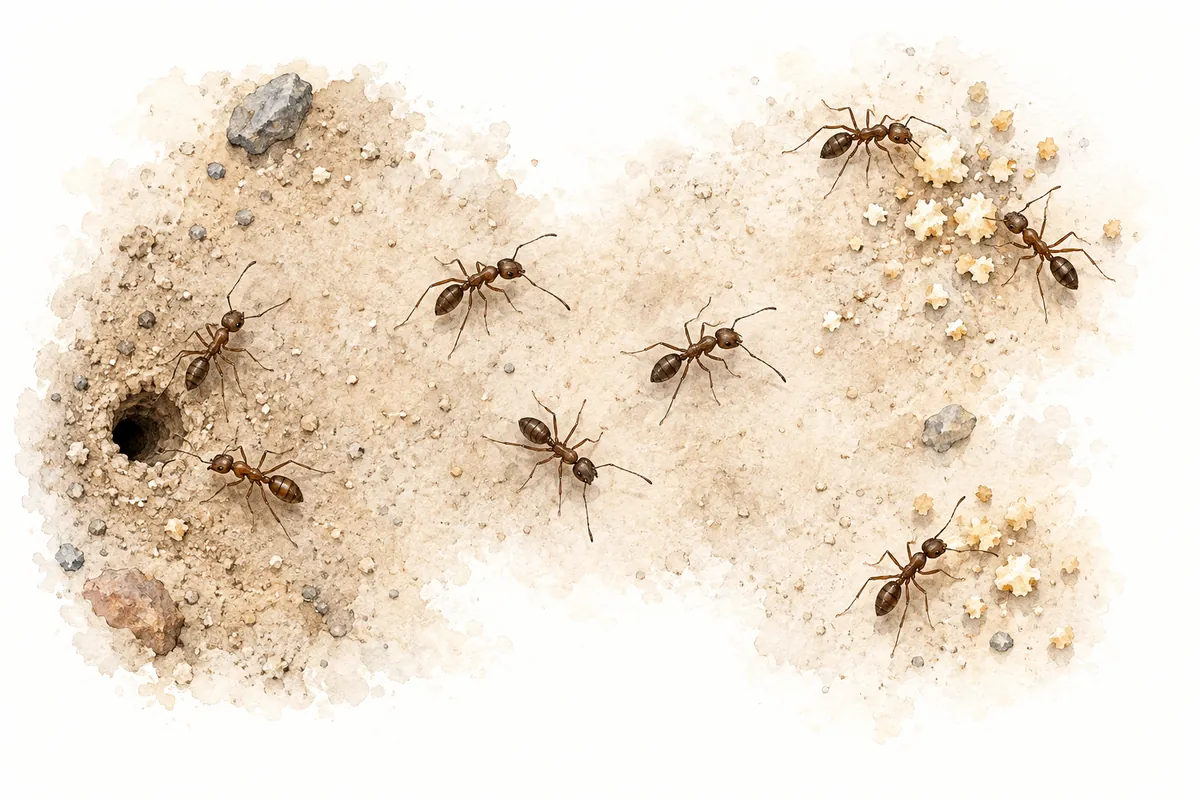
The convenient implementation is a route-planner: something computes a path, ants follow it. Real colonies have no such component. Workers respond to local chemical, tactile and environmental cues, and the trail that appears is the outcome rather than the instruction.
That distinction has measurable consequences. Work on harvester ants quantified how colony size interacts with how food is distributed in the environment, which means foraging performance is a property of the colony and the landscape together — not a stat attached to an ant. A simulation that computes optimal routes centrally has replaced the interesting part of the system with a shortcut.
Food is two problems, not one resource
A single "food" meter is the genre default and it is wrong in a specific, tractable way. Reviews of ant nutrient regulation describe colonies balancing carbohydrate against protein, with the balance shifting according to caste, life stage and what the brood currently needs.
Modelled honestly that gives a colony two competing appetites that change over its life, rather than one bar that empties. A colony with plenty of sugar and no protein is in trouble the meter would not show.
The queen is a constraint, not a commander
The queen is the most-misrepresented element in the genre. She is routinely modelled as a control unit — the thing the player is, issuing orders, whose death is a loss condition.
Her actual role is reproductive, and that makes her a constraint on what the colony can become rather than its decision-maker. Losing her is usually terminal, but slowly and for a specific reason: the colony cannot produce new workers. The queen pages set out what the evidence shows, including how rarely an orphaned colony recovers.
What has to be abstracted
A simulation is a simplification and every rule above is already one. We are not modelling individual chemical gradients, real cuticular hydrocarbon profiles, or the full developmental pathway from egg to adult. Time is compressed enormously. Species differences that matter in the field are collapsed into a handful of archetypes.
The distinction we care about is between simplifying a mechanism and inverting it. Compressing three months of founding into a few minutes is a simplification. Making the queen a commander is an inversion, and we would rather lose the convenience than make it.
Where we will knowingly depart
Some departures are unavoidable. A player needs to see inside a nest that is, in reality, dark and sealed. A player needs feedback in seconds from processes that take weeks. Both break realism deliberately and neither is negotiable.
What we intend to avoid is the third kind of departure: the one that is adopted because it is familiar, then defended as realism afterwards. Where we depart, this page and its successors should say so.
What this page does not claim
Design intent is not a product, and a rule recorded here is not a feature that exists.
- Nothing described above is playable, released, or promised on any date.
- These are design rules, not findings — the findings belong to the cited sources and the pages that own them.
- A simulation built on good sources is still a simulation and is not evidence about real ants.
- Where a rule here conflicts with an EveryAnt article, the article is correct and this page needs updating.
Further reading
Sources and review notes
EveryAnt prioritizes peer-reviewed, university, museum and government sources. Internal source checks do not replace independent specialist review.
- Ant coloniesAustralian Museum · Accessed 2026-09-05
- Quantifying the Effect of Colony Size and Food Distribution on Harvester Ant ForagingPLOS ONE / PubMed Central · Accessed 2026-09-05
- Nutrient regulation in ants (Hymenoptera: Formicidae): a reviewMyrmecological News · Accessed 2026-09-06
- Individual Rules for Trail Pattern Formation in Argentine Ants (Linepithema humile)PLOS Computational Biology (Perna et al., 2012) · Accessed 2026-09-22
Experimental and modelling evidence for local pheromone responses and collective trail patterns. The review illustration is conceptual, not a reconstruction of these data.