
Housekeeping, not a funeral
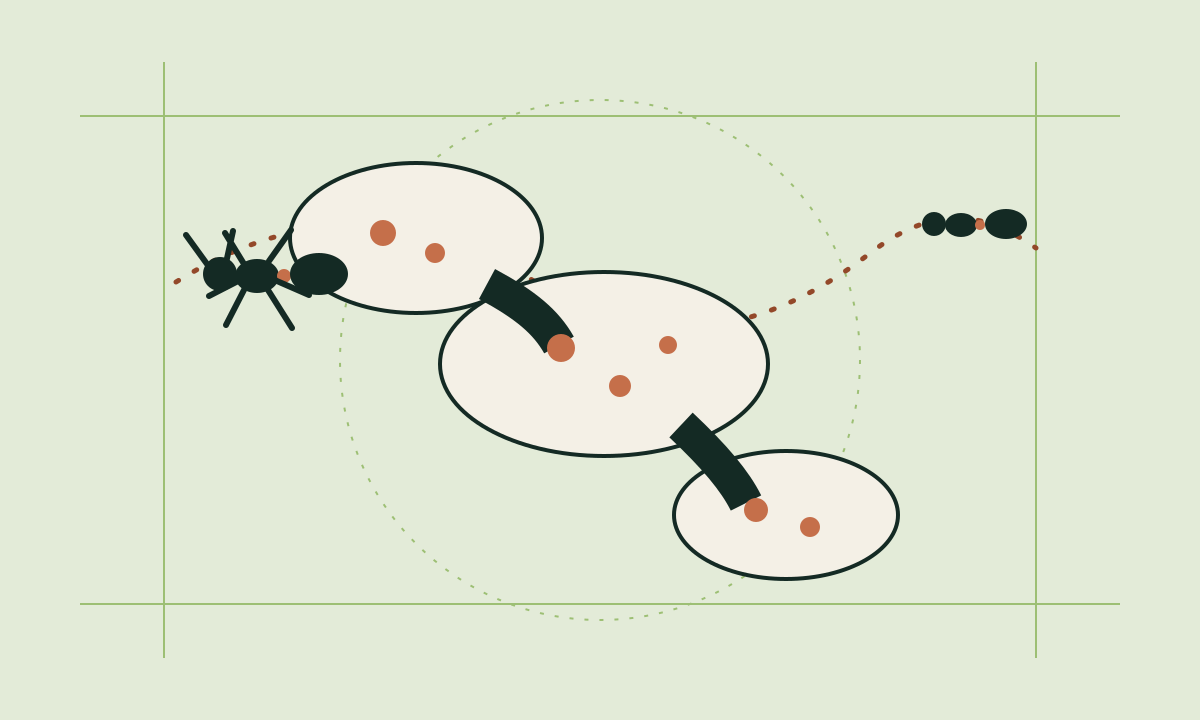
To human eyes, a worker carrying a dead nestmate can look ceremonial. The better biological description is waste management. In many social insects, workers remove corpses from the crowded nest and deposit them in a refuse area.
The behavior is called necrophoresis. It helps limit prolonged contact with decaying bodies and, in some contexts, infectious material. Ant species do not all manage corpses in exactly the same way: removal, burial, avoidance and even consumption have been documented.
How an ant recognizes a corpse
Recognition depends heavily on chemistry. Classic experiments emphasized fatty acids associated with decomposition. Later work with Argentine ants showed that chemicals associated with a living ant can suppress corpse-removal behavior; when those “life signals” disappear, workers respond.
That makes the popular phrase “death smell” useful but incomplete. The timing and cue can differ between species, and colony activity changes how workers respond to the same chemical.
Where the body goes
A worker may carry a corpse outside, place it in a midden with food scraps and nest debris, or move it to a chamber away from brood and living workers. A tidy pile near an artificial nest is not necessarily a cemetery in the human sense.
If you see ants moving another ant, do not assume the carried individual is dead. Ants also transport live nestmates and brood during nest moves or emergencies. Movement and posture provide context, but close observation is needed.
Why hygiene matters in a colony
Warm, crowded nests can favor the spread of microbes and parasites. Social insects therefore combine individual immunity with collective defenses such as grooming, waste separation and corpse management.
Experimental research has found survival benefits when colonies can remove corpses normally. That does not mean every death is infectious, only that reliable housekeeping can reduce risk across many events.
What the behavior tells us
Necrophoresis is a striking example of a colony solving a shared problem without a manager. Individual workers respond to local chemical and behavioral cues; together, those decisions keep living areas separate from waste.
It is sophisticated colony hygiene, but evidence does not support calling it mourning or ritual. The wonder is in the real mechanism: a distributed society maintaining its nest through chemical information.
Recognition is more than one universal “death smell”
Decomposition changes the mixture of chemicals on an insect’s surface. In some classic experiments, fatty acids prompted workers to carry treated objects—and even living nestmates—toward refuse areas. Later work showed that the disappearance of chemicals associated with life can also matter. The response is therefore better understood as a shifting chemical profile than a single magical molecule.
Species, corpse age and cause of death can change the response. Workers may approach a fresh body, groom it, avoid it, carry it away later or handle an infected corpse differently. Ant chemistry is precise, but it is not a barcode reader with one setting for every species.
Who becomes an undertaker?
Corpse removal is often performed by a subset of workers rather than every ant taking an equal turn. Location matters: workers already active near nest entrances or refuse zones encounter different cues from nurses working deep among the brood. Age, experience and individual response thresholds can also influence which ant engages.
That flexibility is valuable. A colony does not need a supervisor to notice that the waste team is busy. More workers can begin responding when corpse-related cues accumulate, while others continue feeding larvae, maintaining chambers and foraging. The job title is temporary; the tiny high-visibility vest is imaginary.
Disease risk explains the caution, not every trip
A dead nestmate can become a microbial resource, especially in warm, humid and crowded conditions. Experiments have found survival advantages when colonies can remove corpses. That supports a hygienic function, but it does not mean every carried ant died from a contagious disease.
Colonies combine several defenses: grooming, antimicrobial secretions, separating waste, removing contaminated material and changing contact patterns. Researchers call these group-level protections social immunity. Like an immune system, the strength lies in layers rather than one perfect behavior.
A careful observation you can make
If a captive colony has a designated refuse area, watch from outside the enclosure and note where food remains, empty pupal cases and corpses accumulate. Do not add dead insects from outdoors or deliberately introduce contaminated material. That would change a harmless observation into an uncontrolled health experiment.
In the wild, photograph a worker and its load without blocking the route. A curled ant may be dead, but workers also carry living nestmates, pupae and prey. Record what you can actually see. “Worker transported another ant-shaped object” may sound less cinematic than “ant funeral,” but it is excellent field-note discipline.
Sources and review notes
EveryAnt prioritizes peer-reviewed, university, museum and government sources. These pages have completed an internal source and scope pass; independent subject-matter review remains recommended before a production launch.
- Chemical signals associated with life inhibit necrophoresis in Argentine ants — PNAS / PubMed Central. Accessed 2026-09-05.
- Corpse Management in Social Insects — International Journal of Biological Sciences / PubMed Central. Accessed 2026-09-05.
- Keep the nest clean: survival advantages of corpse removal in ants — Biology Letters / PubMed Central. Accessed 2026-09-05.