
Diapause, not hibernation
Hibernation describes a specific set of adaptations in warm-blooded animals: a controlled drop in body temperature and metabolic rate in an animal that would otherwise maintain both. Ants do not regulate their body temperature in the first place, so the word does not transfer.
The accurate term is diapause — a programmed pause in development and activity that many insects use to cross an unfavourable season. It is not sleep, and it is not simply being too cold to move. It is a distinct physiological state the animal enters and leaves.
The colony enters it, not just the ants
Dormancy can involve both individual physiology and colony activity. Queen egg-laying, worker foraging and brood development change together. The species in the cited study differed in whether larvae remained during dormancy, so a resting colony need not contain the same brood stages as an active one.
That collective shift is why a colony in winter is not simply a group of sluggish ants. It is a superorganism that has stopped growing, and it resumes as a unit in spring.
The colony runs a clock
Cold weather is not the whole explanation. In the temperate seasonal pattern discussed by Willot and colleagues, an internally timed colony cycle can lead into dormancy even when food and favourable temperatures remain available.
After warming ends dormancy in spring, the colony enters a growth period of roughly fixed length. When that period runs out, the colony enters dormancy again on its own schedule, with limited flexibility, even if the weather is still mild and food is still available. Kipyatkov, who established much of this, described the mechanism as a sand-glass device: something that runs down rather than something that senses.
What the recent evidence adds
Willot and colleagues worked across five temperate species to separate the colony’s internal programme from simple exposure to cold. They measured worker metabolic rates, metabolomic profiles and cold tolerance, and found that seasonal cold tolerance tracks the colony’s endogenous dormancy rather than thermal exposure alone.
Both cold acclimation and the colony’s dormant state contributed to the measured responses, with differences among species and physiological measures. The result supports a role for internal seasonal state alongside exposure to cold; it does not make temperature irrelevant.
Larvae and adults differ
The two levels are not governed identically. Larval dormancy in these species is generally facultative — it can be induced or avoided, influenced by temperature and by the behaviour of the nurse workers around the brood.
Adult dormancy is obligate: it happens on schedule regardless, with ovaries inactive and workers unable to sustain rapid brood development. That asymmetry is part of why a colony cannot simply be warmed back into productivity in midwinter.
Where they actually spend the winter
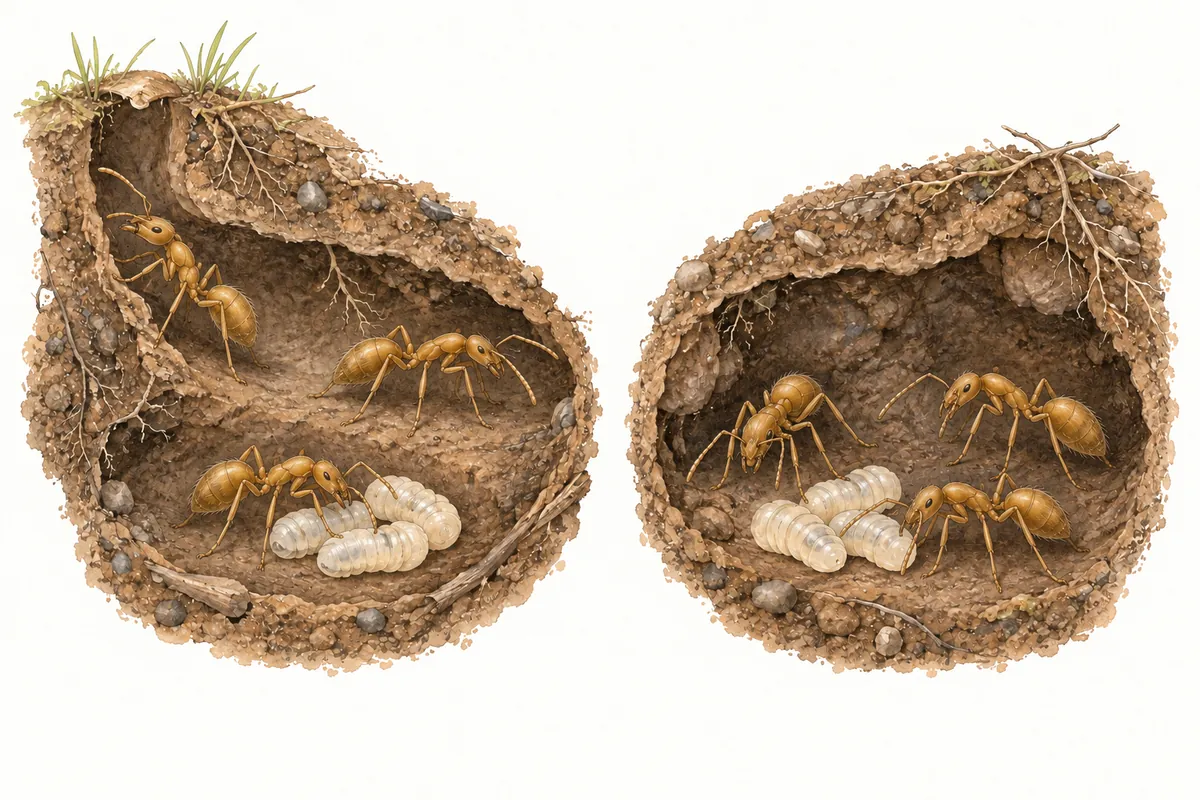
The wintering place depends on nesting biology and local conditions. A soil nest, a cavity in dead wood and a sheltered space under a stone provide different environments. The cutaway is a teaching convention and gives no measured nest depth.
Species differ in the details. Some overwinter under stones that gain heat on bright days, some inside dead wood, some deep in soil. Depth is a function of the species, the substrate and the local climate, and no single figure describes it.
What you might notice
Above ground, the noticeable change can be reduced traffic at a nest entrance or along a familiar trail. The timing depends on species and place; a quiet entrance alone does not establish that a colony is dormant.
Indoors, ants appearing in a heated building in midwinter usually indicate a nest inside the structure or in a warm cavity against it, rather than a colony that has ignored the season. That is a different question, and the household guidance covers it.
What this cannot tell you
This account concerns a pronounced temperate seasonal pattern. The cited experiment cannot establish how all tropical, subtropical or temperate ants respond to their own seasonal conditions.
- Do not apply this to tropical or subtropical species; the pattern is a temperate adaptation.
- Do not read a warm-weather emergence in winter as a colony failing to hibernate — it more likely indicates a nest indoors.
- Do not infer nest depth, temperature or species from the absence of surface activity.
- The internal-timer finding comes from a small set of temperate species and should not yet be treated as universal.
Further reading
Sources and review notes
EveryAnt prioritizes peer-reviewed, university, museum and government sources. Internal source checks do not replace independent specialist review.
- Endogenous colony dormancy shapes seasonal cold tolerance in temperate antsFunctional Ecology (Willot et al., 2026) · Accessed 2026-09-21
Across five temperate species, cold tolerance tracks an internally scheduled colony dormancy rather than exposure to cold alone. Colonies follow a fixed growth period governed by an internal timer — Kipyatkov’s “sand glass device” — and enter obligate dormancy even when conditions remain favourable.
- Ant coloniesAustralian Museum · Accessed 2026-09-05