
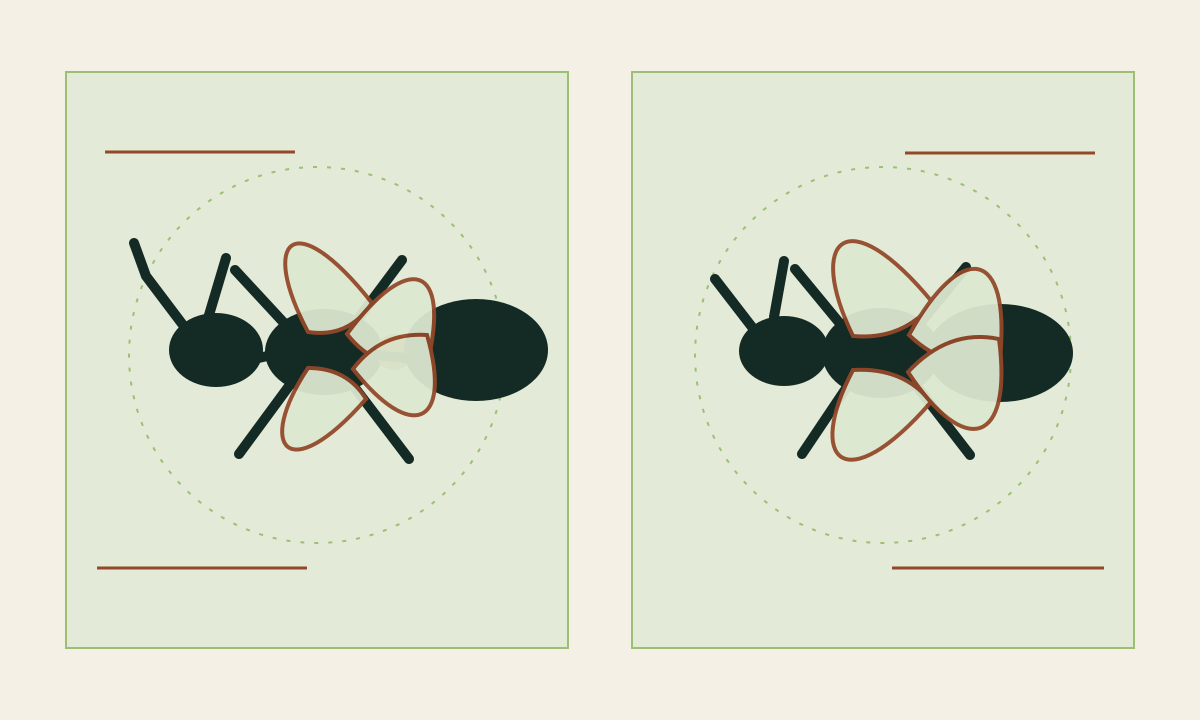
Why color is a weak field mark
Many unrelated ants are dark. Some carpenter ants are black; others are reddish, brown or bicolored. Treating every black worker as the same “black ant” can hide meaningful differences in nesting and risk.
Color also changes with lighting and photographs. Use it as one clue after size, body shape, location and nest evidence—not as the deciding feature.
Size helps, within limits
Carpenter ants are among the larger ants commonly found in North American buildings, and workers within one colony can vary noticeably in size. Many nuisance house ants are much smaller.
A measurement is more useful than “big.” Photograph the ant beside a millimeter ruler without crushing its shape. Remember that reproductive ants are larger and winged, and a small worker is not automatically a different species.
Body shape under magnification
Carpenter ants have elbowed antennae, a single waist node and a smoothly curved upper profile on the mesosoma when viewed from the side. Those features require a sharp close view; they are easy to invent in a blurry image.
Other dark ants may have two waist nodes, a more uneven profile or other diagnostic structures. A reliable species identification often needs an intact specimen and regional key.
Nest evidence changes the stakes
Large ants foraging indoors may come from an outdoor nest. Repeated activity from damp structural wood, coarse frass, or workers appearing after dark close to one opening makes a carpenter-ant nest more plausible.
Carpenter ants excavate wood but do not eat it. Moisture damage often comes first, so inspection should consider leaks and decay rather than treating the insect as the only problem.
A practical decision
If the ants are tiny and visiting food, document the trail and seek identification before choosing bait. If they are large, variable in size and linked to wood or frass, arrange a closer inspection.
The goal is not to win a two-label guessing game. It is to identify the ant closely enough to protect the building and choose a proportionate response.
The comparison begins with a category error
Carpenter ant names a genus-level group, Camponotus. “Black ant” usually describes appearance. The two categories overlap, so asking which one you have is rather like asking whether a bird is a crow or a black bird. A crow may satisfy both descriptions; many other dark birds do not.
This matters because web comparisons often invent two tidy opponents: a large destructive carpenter ant and a small harmless black ant. Nature did not sign that design brief. Several dark ants enter buildings, carpenter-ant species vary in color, and practical significance depends on nesting evidence as well as anatomy.
Measure instead of estimating “large”
Worker carpenter ants commonly show substantial size variation within a colony. That polymorphism can be a helpful clue when distinctly different-sized workers share the same trail. Yet size ranges overlap with other ants, and perspective makes phone photographs unreliable.
Place a ruler beside a contained or dead specimen without flattening it. Record body length from the front of the head to the end of the abdomen, excluding antennae. A millimeter value is far more transferable than “about the size of a normal ant,” because normal has several thousand species competing for the role.
Observe the trail after dark
Carpenter ants often forage from late day into night and may travel a considerable distance from an outdoor nest. Use a flashlight along foundations, branches touching the building, service lines, deck posts and the edges of damp wood. Watch both directions: workers returning with distended abdomens or prey can help reveal which way the nest lies.
One large ant indoors does not prove an indoor colony. Repeated workers from the same void, winged ants emerging inside, fresh coarse debris or faint activity in wood make that interpretation stronger. A trail leading outside can instead point toward a main nest in a stump, tree or stored firewood.
Use a bundle of clues
No single easy character should carry the full decision. Color is weak, size overlaps, and even the smooth carpenter-ant body profile requires a clean side view. Combine anatomy with worker-size variation, time of activity, moisture, frass and the direction of travel.
If the building question matters, preserve the uncertainty in your notes. “Large dark ants repeatedly exiting a damp window frame after sunset” is actionable evidence even before a species-level identification. “Definitely carpenter ants because black” is confident but considerably less useful.
- Anatomy: elbowed antennae, one waist node and side profile.
- Colony clue: workers of noticeably different sizes on one trail.
- Building clue: recurring mixed frass near damp or hollow wood.
- Escalation clue: indoor swarmers or activity from structural material.
Sources and review notes
EveryAnt prioritizes peer-reviewed, university, museum and government sources. These pages have completed an internal source and scope pass; independent subject-matter review remains recommended before a production launch.
- Carpenter Ants — University of Maryland Extension. Accessed 2026-09-05.
- Carpenter Ants — University of California Statewide IPM Program. Accessed 2026-09-05.
- Ants — Cornell Integrated Pest Management. Accessed 2026-09-05.