
What are ants actually doing in the grass?
An ant moving between grass stems might be carrying food, searching for it or returning to its nest. Its presence alone does not tell you which.
The short answer draws on regional accounts of lawn ants, seed collection and Texas leafcutters. Minnesota Extension, UConn, Texas A&M
These are documented examples, not a species-identification key. Different ants can perform different activities in the same lawn.
Scroll sideways to see all columns.
| Activity or example | What the ants obtain | Relationship to grass | Source |
|---|---|---|---|
| Lawn-foraging ants taking insects | Prey or scavenged animal material | They are finding food among the grass, rather than necessarily consuming the plant. | University of Kentucky |
| Ants attending aphids | Honeydew, a sugary liquid released by sap-feeding insects | The ants collect a product of another insect’s feeding. | UConn |
| Seed-harvesting ants | Seeds, including grass seeds in documented populations | Eating a seed is different from eating a growing blade. Preferences vary among species. | Australian field research |
| Texas leafcutting ant, Atta texana | Plant material used to cultivate fungus | Grasses are among the plants harvested. The fragments become growing material for the fungal crop. | Texas A&M |
| Ants excavating lawn nests | Space for tunnels and chambers | Moving soil can affect nearby roots and turf without the ants consuming leaves. | Illinois Extension |
Do ants eat grass seeds?
Some do. Seed-harvesting ants gather seeds as food, although the importance of seeds and the kinds selected differ among species.
Research in northern Australia’s Kakadu region examined discarded seed material around harvester-ant nests. Grass seeds dominated those remains, but different ant species concentrated on different seed types. The researchers also compared material carried by returning workers with nest refuse for one of the studied ants. This is evidence from Australian savanna populations, not a description of every American lawn. Andersen and colleagues
Seed collection can matter after a lawn has been sown. UConn notes that ants may consume grass seed or take it into their nests, preventing some seeds from germinating where they were scattered. UConn
Watch what actually happens before drawing a conclusion. Seeing a worker carry a seed establishes transport; it does not reveal the seed’s eventual fate. Likewise, an empty patch in a newly seeded lawn is not, by itself, proof that ants removed the seeds.
Why do some ants cut grass and leaves?
Leafcutters use harvested vegetation to support an underground food-growing system:
Plant material collected → fungus garden supplied → cultivated fungus provides food.
The Texas leafcutting ant, Atta texana, is a US example. Texas A&M lists grasses among the plants it can damage and describes workers taking fragments underground to cultivate fungus. This is different from grazing on the blades directly. Texas A&M
Do not assume that every leafcutter harvests the same plants. Our Atta cephalotes profile explores another fungus-farming species; it should not be used to identify the Texas ant or every worker carrying greenery.
A closer look
A leafcutter carrying vegetation
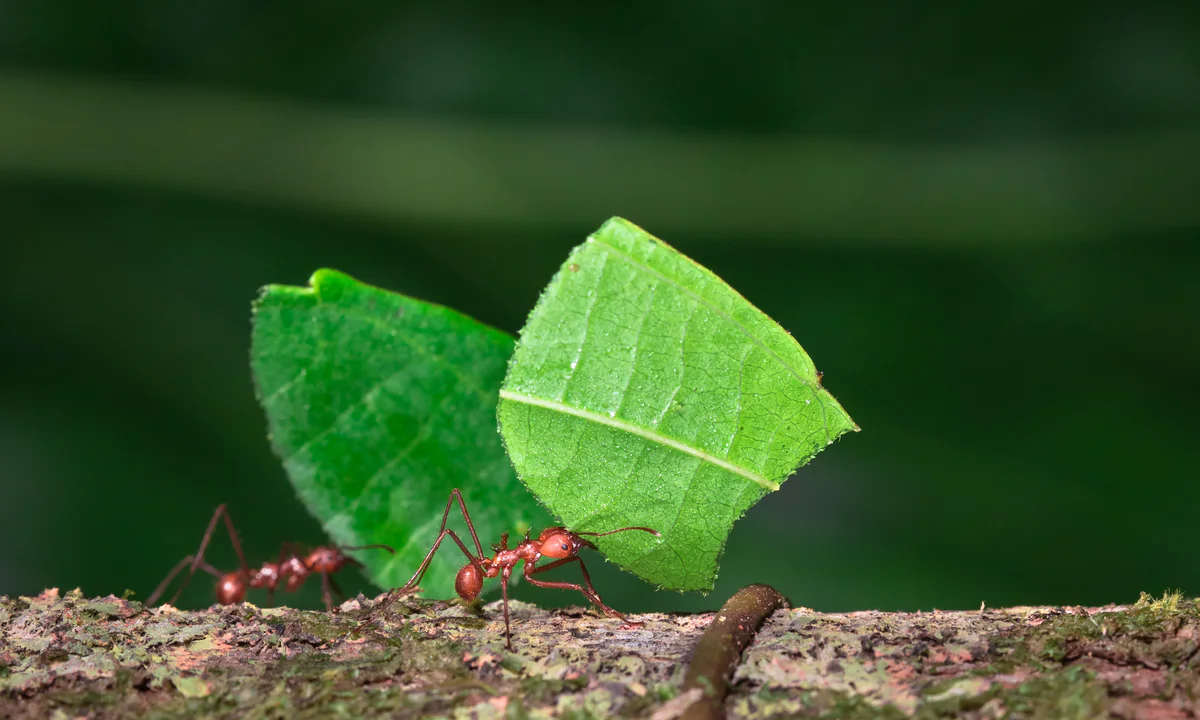
A leafcutter carries plant material in Costa Rica. Leafcutters use harvested vegetation to cultivate fungus. This photograph does not identify the ant to species or show grass being eaten.
Photo: Kevin Wells / stock.adobe.comWhat do ordinary lawn ants eat instead?
Many ants find animal food and sugary liquids in grassy habitats. The University of Kentucky describes Lasius ants feeding on lawn insects, including cutworms and sod webworms, and sometimes attending sap-feeding insects for honeydew. Ants also scavenge dead insects. A worker beside a damaged plant may therefore be collecting an insect rather than attacking the plant itself. University of Kentucky
Honeydew is a sugar-rich liquid excreted by insects such as aphids and scale insects. Ants collecting it have an indirect connection to the plant: the sap-feeding insect takes plant fluids, and the ant obtains honeydew. Food preferences can also change with the species and the colony’s needs. Minnesota Extension
There is no single menu for every ant in a lawn. Ants are also food for other animals; our guide to what eats ants explains that side of the food web.
A closer look
Three different food relationships
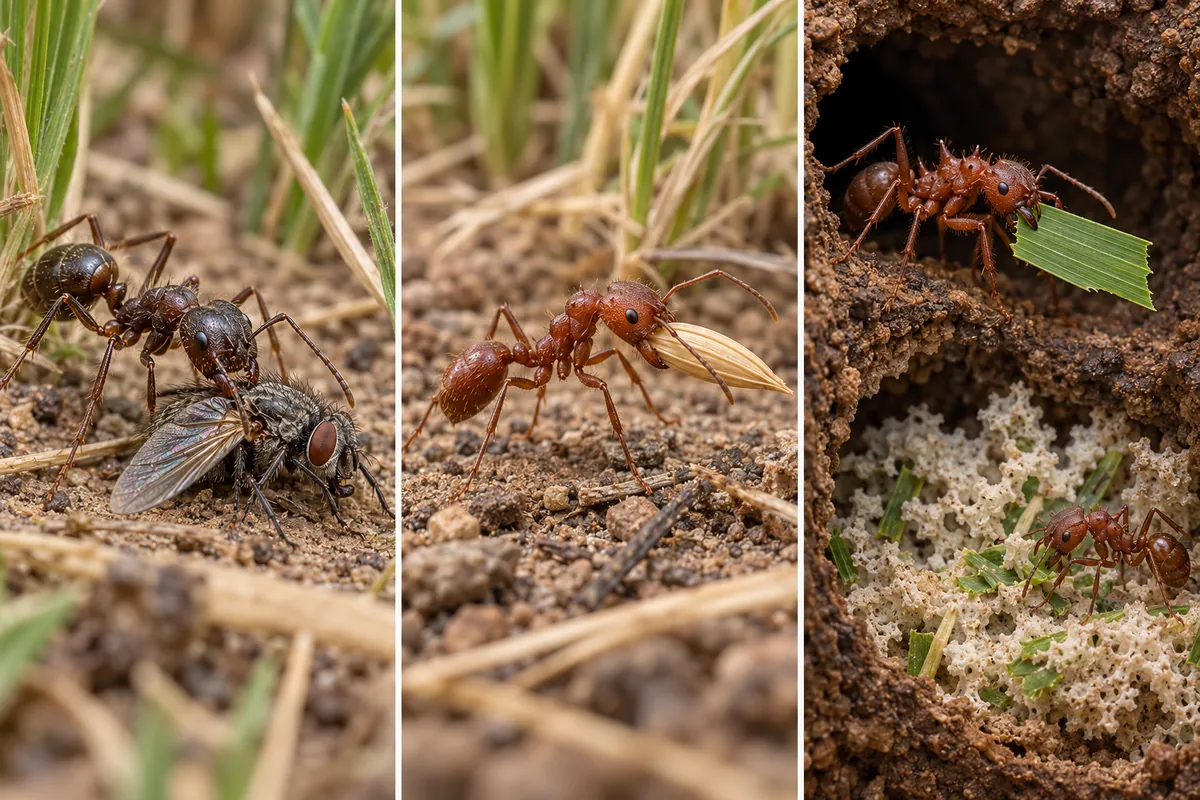
Three different relationships between ants and food in grassy habitats. Representative scenes, not one species or shared habitat; simplified and not to scale. AI-generated explanatory illustration. The nest chamber is shown in cutaway and illuminated for explanation.
Can ants damage grass without eating it?
Yes, localized damage can result from nesting activity. Illinois Extension describes small areas of turf dying where excavation removes soil near roots and allows them to dry. That mechanism does not require ants to bite or consume the leaves. Illinois Extension
UMass also describes root disturbance, drying around tunnels and grass covered by large mounds. However, its New England guidance says ants generally cause little trouble in home lawns and seldom reduce the vigor of moderately maintained turf. Possible damage does not mean every nest needs intervention. UMass Amherst
Ants beside a brown patch do not establish what caused it. A mound, missing leaf tissue and a patch that failed to germinate are different observations. Record them separately rather than treating all three as evidence of “ants eating grass.”
The distinction also helps explain why a busy nest entrance can coexist with otherwise healthy grass: visible ant activity is not a measurement of plant damage.
How to interpret ants in your lawn
Start with a short observation from the edge of the activity:
- Record the location. Country and region help put a possible identification in context.
- Look at what workers carry. Note seeds, green fragments, insect parts or soil. A close photograph may be more useful than a guess.
- Watch the action. Cutting a blade, transporting a fragment and standing on a plant are different behaviors.
- Separate plant changes from nest signs. Photograph missing tissue, loose-soil mounds and thinning areas individually.
- Leave the activity undisturbed. Avoid opening nests or offering food to manufacture an interaction.
- Ask for local identification when needed. If damage persists, a local extension service can help assess the ants and the turf separately.
A useful observation might be “workers carrying seeds toward a soil opening,” rather than “ants destroying the lawn.” The first records something another observer can check.
For the relationship between those surface workers and the nest below, see our introduction to ant colony biology.
Further reading
Sources and review notes
EveryAnt prioritizes peer-reviewed, university, museum and government sources. Internal source checks do not replace independent specialist review.
- AntsUniversity of Minnesota Extension · Accessed 2026-10-17
- Lawns: Common Insect PestsUniversity of Connecticut · Accessed 2026-10-17
- Ants in Kentucky Landscapes and GardensUniversity of Kentucky · Accessed 2026-10-17
- Seed selection by an exceptionally rich community of harvester ants in the Australian seasonal tropicsAndersen, Azcárate and Cowie, Journal of Animal Ecology (2000) · Accessed 2026-10-17
Kakadu savanna populations; nest-refuse analysis with a direct-foraging comparison for one studied ant. Not a description of every US lawn.
- Texas Leaf Cutting AntTexas A&M AgriLife Extension · Accessed 2026-10-17
- Ants [Turfgrass]University of Illinois Extension · Accessed 2026-10-17
- Ants in LawnsUMass Amherst · Accessed 2026-10-17
New England turf context. Used for nesting effects and their generally limited impact, not its pesticide recommendations.