
“Hate” is the wrong scientific word
A repellent changes where an ant chooses to walk, forage or nest. It does not require a human-like dislike, and it does not prove that the substance kills ants or controls a colony.
Popular lists often combine undiluted oils, kitchen powders, plants and cleaning liquids as if they were equivalent. Concentration, formulation, surface, age of the deposit and ant species can all change the result.
What research supports
Controlled studies have found deterrent effects from certain mint oils, cinnamon compounds, citronella, tea tree oil and d-limonene against selected species. Some effects persisted in experimental settings; others weakened as volatile compounds aged.
A 2024 study of Argentine ants also found that several commonly recommended materials did not reliably dislodge ants from a preferred harborage. Food attraction can outweigh a weak repellent. Evidence is therefore specific, not a universal ranking of smells.
Why a trail may move rather than vanish
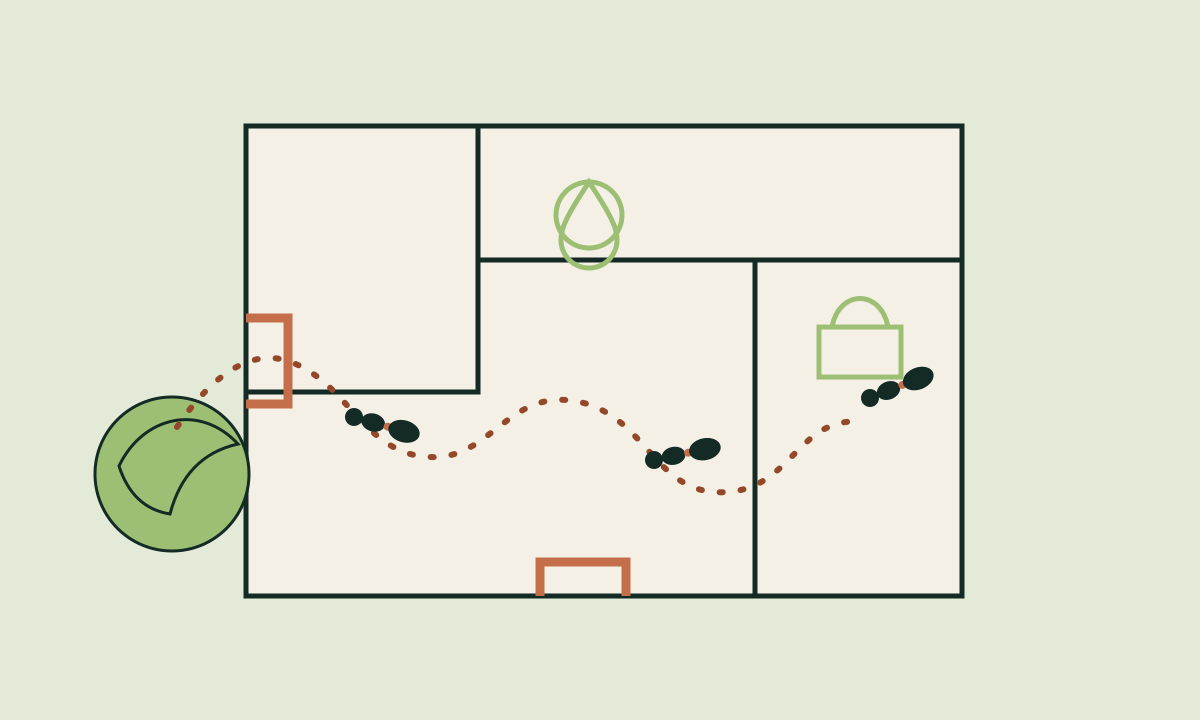
Ants use chemical information to navigate. Cleaning a trail or placing a repellent across it can disrupt that route, but workers may search around the barrier and establish another path.
If food, water or a suitable nest remains available, the underlying reason for activity remains. This is why a strongly scented kitchen can still have ants.
Essential oils are active chemicals
Concentrated oils can irritate skin and airways, harm pets, stain finishes and be unsafe when swallowed. “Natural” describes origin, not risk. Never apply an improvised mixture to food-contact surfaces, animals, nests of unknown stinging ants or places accessible to children.
A registered product has directions for its formulation and approved uses. Follow that label. Do not assume a research concentration or social-media recipe is safe to reproduce at home.
Use the evidence proportionately
For a few foragers, clean food residues and trails, dry moisture, seal suitable gaps after observing the route, and monitor. A short-lived repellent may support exclusion in a limited spot, but it should not be sold as permanent control.
For repeated activity, identify the ant and target the colony with an evidence-based plan. Some species bud or relocate when disturbed, making blanket repellent use counterproductive.
Ants do not experience a scent list the way we do
Ants detect chemicals with sensory organs, especially on their antennae, and use those signals to recognize nestmates, follow routes, find food and assess danger. A substance that smells powerful to a human nose may not affect the relevant ant at the same concentration or on the same surface.
“They hate cinnamon” compresses several unanswered questions: Which species? Cinnamon powder or a measured compound? Fresh or aged? On glass, wood or soil? Competing with food or used alone? A useful claim names those conditions. A viral list usually sends them all on a long lunch break.
Laboratory repellence is not household control
In a choice test, researchers may measure whether ants cross a treated line or enter one arm of an arena. That can demonstrate repellence under the test conditions. It does not show that sprinkling a kitchen ingredient around a home will reach a queen, suppress brood or prevent workers finding another route.
Field performance introduces sunlight, airflow, porous materials, rain, cleaning, competing odors and a much larger search area. Volatile oils also change as they evaporate. A strong effect at the start of an experiment may weaken quickly, and repeatedly reapplying concentrated material can increase exposure without solving the colony.
Repellent, toxic and disruptive are not synonyms
A repellent discourages approach. A toxicant causes harmful effects at a dose. A trail cleaner may remove chemical cues without remaining repellent. Those actions can overlap, but a study of one should not be quoted as proof of the others.
This distinction matters for management. Driving workers away from one crack can make activity less visible while food and nesting conditions remain. Killing exposed workers can leave the reproductive colony intact. Disrupting a trail may provide a useful clean start for monitoring, but the ants are perfectly capable of holding a route-planning meeting without inviting us.
A better low-exposure sequence
Begin with the resource: clean residues, seal food, manage pet bowls and dry moisture. Wipe the trail with an ordinary surface-appropriate cleaner, observe where activity returns and seal durable entry gaps after confirming they are not hiding a structural problem.
If ants persist, obtain an identification and use extension or licensed professional guidance for the species and setting. Any pesticide—including a product marketed with plant-derived ingredients—must be used according to its label. Keep materials away from children, pets and food, and never reproduce a research formulation as a household recipe.
- Use scent only as a limited behavioral tool, not a colony-eradication promise.
- Test surface compatibility before applying any cleaner.
- Stop if people or animals show irritation.
- Reassess the resource and route when ants simply move elsewhere.
Sources and review notes
EveryAnt prioritizes peer-reviewed, university, museum and government sources. These pages have completed an internal source and scope pass; independent subject-matter review remains recommended before a production launch.
- Common Home Remedies Do Not Deter Argentine Ants from a Preferred Harborage — Journal of Economic Entomology / PubMed Central. Accessed 2026-09-05.
- Evaluation of Four Plant Extract Repellents for Management of the European Red Ant — Journal of Economic Entomology / PubMed. Accessed 2026-09-05.
- Ants — University of Minnesota Extension. Accessed 2026-09-05.